Practical Learning Activity
Skills

Practical
Take notes and answer questions as you read and learn.
Introduction to Elementary Calculus
There are three main areas of calculus. These are derivatives, integration and limits.
Derivatives
Derivatives tell you the rate of change. They are functions that give you the slope of a particular x value of the tangent line of an original function.
You will find derivatives stated in several different notations, but they mean the same thing. Derivatives are often stated in the Leibniz notation as,
$$\frac{dy}{dx}\;= ,\;or \;\frac{d}{dx}f(x)= $$ the last of which literally means the derivative of the function at point x.
Derivatives are also commonly stated in Lagrange notation using ′ for prime as,
$$f \;′(x), \;$$or for the second derivative, $$f \;′′(x)\;$$or for the third derivative, $$f \;′′′(x)$$
which also literally mean the derivative of the function at point x.
The Power Rule for Derivatives and an Example
The power rule is used when finding a derivative and is as follows,
$$\frac{d}{dx}x^n\;=\;nx^{n-1}$$
Using the power rule (above) to find the derivative of,
$$\frac{d}{dx}[3x^8]\;=$$
Multiply the coefficient of x, along with x, by the amount of the power , which is 8, which gives a total of 24x. Then take 1 off n to calculate the power, which in this case brings 8 down to 7, giving the following result,
$$\frac{d}{dx}[3x^8]\;=\;24x^7$$
Try applying the derivative power rule to find the following derivatives.
Show Answer
$$\;28x^6$$Show Answer
$$\;9x^2$$Show Answer
$$\;28x^3$$Show Answer
$$\;25x^4$$Show Answer
$$\;27x^8$$Integration
While derivatives are precise measurements of instantaneous changes, integration tells you how much something accumulates over time and is ultimately looking to see a total quantity. Integration is the concept of derivatives in reverse, being concerned with finding the anti-derivative. With integrals, you are finding the area under the curve.
The Power Rule for Integration or Anti-derivatives and an Example
The power rule for integration is as follows,
$$∫[x^n]dx=\frac{x^{n+1}}{n+1}+\;c$$
Note that this does not apply where n = -1 because that leads to division by zero.
The variable c is the constant of the equation.
To integrate the following,
$$12x^2$$
we substitute the values into the power rule for integration and then work out the equation as follows,
$$∫[12x^2]dx=\frac{12x^{2+1}}{2+1}+\;c$$$$=\frac{12x^{3}}{3}\;+\;c, $$$$=\;4x^3+c,\; $$
The power rule for integration works in reverse to the power rule for derivatives. This can be demonstrated by applying the power rule for derivatives to the answer which we just found by using the power rule for integration. Keep in mind that the derivative of any constant is zero, so whenever we are finding the derivative, whatever the constant, it makes no difference to the result. Once again, the power rule for finding the derivative is,
$$\frac{d}{dx}x^n\;=\;nx^{n-1}$$
to find the derivative of the answer that we found through integration, $$4x^3,$$
Using the power rule for derivatives to work out the solution as shown,
$$\frac{d}{dx}[4x^3]\;=12x^2,$$
The result is the same answer we started with, to which we first applied the power rule for integration.
Try applying the anti-derivative power rule to integrate the following.
Show Answer
$$\;4x^4+c$$Show Answer
$$\;2x^4+c$$Show Answer
$$\;3x^5+c$$Show Answer
$$\;x^6+c$$Show Answer
$$\;3x^4+c$$Limits – An Example
A limit describes the movement of a function as its input approaches a particular value.
Limits are written as follows,
$$\lim\limits_{x \to a} f(x) = L,$$
This is a mathematical way of saying the limit as x of the function approaches a, equals L.
Limits also help to evaluate a function, where it cannot be directly worked out. It gives us the results of approaching a particular value for the x variable of the function. A limit becomes undefined or indeterminate when direct substitution yields division by zero.
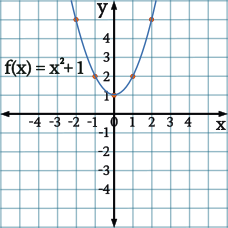
The following question is asking to find the limit as x approaches 2.
$$\lim\limits_{x \to 2}{x^2+1}=?$$
Initially, 2 can be substituted into x. As substituting 2 into this equation gives a direct result, the limit of 5 as shown here, that is the answer .
$$\lim\limits_{x \to 2}{2^2+1}= 5$$
This is to say that as x of the function approaches 2, the limit of what the function can equal is 5. The graph of the function is as follows, and you can see here that as x approaches the value of 2, y approaches 5, but will go no higher than 5 by the time x reaches 2.