
Practical Learning Activity
Learn

Practical
Take notes and answer questions as you read and learn.
What are Factors?
Factors are the whole numbers that you can multiply together to get a certain whole number. For instance 2 x 2 = 4, so 2 is a factor of 4. And 1 x 4 = 4, so 1 and 4 are also factors of 4. In fact, the number itself and 1 are always the most obvious factors and sometimes the only factors of a number.
5 x 3 = 15, so 5 and 3 are both called factors of 15. Since 5 and 3 can be multiplied to get 15 they are also called a factor pair. 15 is known as a multiple of both 5 and 3, because both of them can be multiplied to get 15. You could also say 15 is divisible by 3, and 15 is divisible by 5.
Try the following.
Show Answer
5
Show Answer
1, 2, 5, and 10
Show Answer
7
Show Answer
1, 2, 4, 7, 14, and 28
Another Example
Look at the following equations, or mathematical sentences, $$16\; ÷ \;2 \;= \;8$$$$16\; ÷ \;8 \;= \;2$$As you can see, both 2 and 8 can divide 16 perfectly, without a remainder. Therefore 2 and 8 are both called factors of 16.
Times Tables
Knowing the times tables in maths helps us solve maths problems, not only by enabling us to answer large multiplication questions, but also because knowing the times tables makes it easier to think of the factors of numbers.
Remember to practice your times tables regularly. Set yourself targets for learning the different tables up to the 12 times tables. You can practice your times-tables here.
Make a Factor Tree
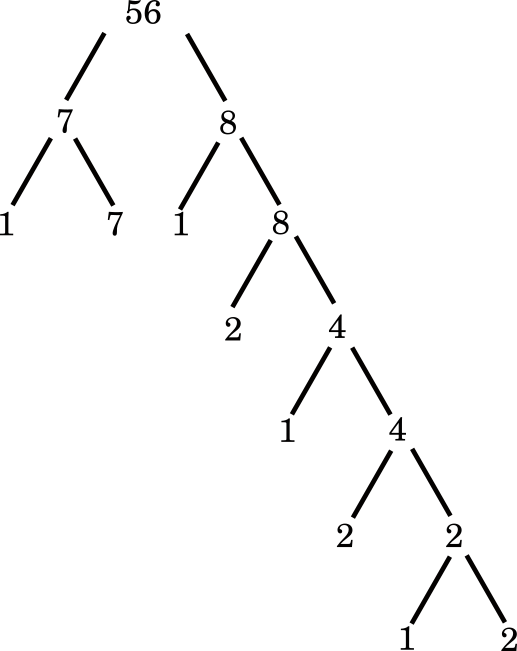
A factor tree can help us to know the larger factors of numbers. Here is an example of a factor tree. To make a factor tree, we put in what we know and do not immediately have to put all of the factors in the tree. For instance, to begin with, we might just know that, besides the obvious factors of 56 and 1, 56 has two factors, 7 and 8, and start making our factor tree with that information only, as shown here,
How a Factor Tree Helps
The numbers beneath each of the numbers in the tree are all factors which can be multiplied to get the number above. Even the numbers at the lowest parts of the tree can be multiplied to get the number right at the top, so making this tree can help us to identify new factors. For instance, seeing that 2 is a factor of 4 right near the base of the tree, 2 must also be a factor of 56 at the top. And if we ask the question,$$56\; ÷ \;2 \;= \;?$$we find out that there are 28. So 28 is also a factor of 56.
Try making a factor tree for some numbers you know.
See if you can answer the following questions relating to factors.
Write down as many factors of the following numbers as you can, and then check each answer with, ‘Show Answer,’ to see how many you found.
1) 8 (hint – there are four factors)
Show Answer
1, 2, 4, and 8
2) 15 (hint – there are four factors)
Show Answer
1, 3, 5, and 15
3) 10 (hint – there are four factors)
Show Answer
1, 2, 5, and 10
4) 20 (hint – there are six factors)
Show Answer
1, 2, 4, 5, 10, and 20
5) 12 (hint – there are six factors)
Show Answer
1, 2, 3, 4, 6, and 12
6) 30 (hint – there are eight factors)
Show Answer
1, 2, 3, 5, 6, 10, 15, and 30
7) 4 (hint – there are three factors)
Show Answer
1, 2, and 4
8) 25 (hint – there are three factors)
Show Answer
1, 5, and 25
9) 24 (hint – there are eight factors)
Show Answer
1, 2, 3, 4, 6, 8, 12, and 24
10) 14 (hint – there are four factors)
Show Answer
1, 2, 7, and 14
You can practice your times-tables here
(Go to the Number Patterns page)
(Go to the Tell the Time page)
(See free activities by grade here) or (by subject here)