
Understanding Fractions (First Fractions Classes 1.1 and 1.2)

Further Fractions 2 (Classes 2.1 and 2.2)
Adding and Subtracting Fractions (Class 3.1 Final Fractions Class)
(Fractions Test for when Classes are completed)
Further Fractions
Fractions Class 1.3
Improper and Proper Fractions
While the fractions where the numerator is more than the denominator are called improper fractions, those where the numerator is less than the denominator are called proper fractions.
Here are three examples of improper fractions being converted into a mixed number.
a)$$\frac{17}{10}=1\frac{7}{10}\;$$b)$$\frac{6}{5}=1\frac{1}{5}\;$$c)$$\frac{17}{8}=2\frac{1}{8}\;$$
In each instance, the wholes are calculated by how many of the denominator’s value are in the numerator’s value, giving you the final whole number. The fraction remainder is the leftover numerator amount which was not counted in the whole numbers because it was not large enough. For instance, in example a), since the unit or denominator is 10, it would take 10 in the numerator to make one whole number, and we have that. With just 7 remaining, we cannot make another whole number, so the resultant mixed number is one and seven tenths.
In example b), above, the unit or denominator is 5. Since 6 contains one five and there is 1 leftover, the final mixed number is one and one fifth. In example c) , above, the unit or denominator is 8. Since 17 contains two eights, which make 16, and there is 1 leftover, the final mixed number is two and one eighth.
The following fraction is an example of a proper fraction.
$$\frac{2}{3} $$

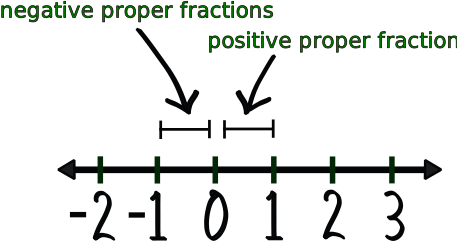
Two thirds is a proper fraction, because the numerator is less than the denominator. In effect, every proper fraction has a total value of less than one and greater than zero, or in the case of negative fractions, greater than minus one, and less than zero. Simplification of a proper fraction will never produce a whole number.
Simplifying Improper and Proper Fractions
Once we have a result, where possible, we can and should further simplify proper and improper fractions. Some of these fractions can be simplified by dividing the numerator and the denominator by a common factor.
In the following example, the denominator and the numerator are divisible by the same number and thus, the fraction can be simplified;
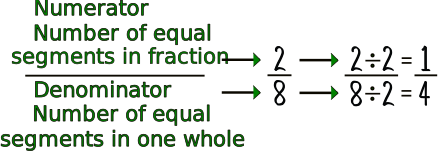
We can see that the 2 and 8, the numerator and the denominator of the initial fraction two eighths, both have the factor 2. The initial fraction is simplified by the same division for both, achieving a final result of one quarter.
Fractions can be simplified to the greatest possible extent with the Greatest Common Divisor or GCD . To find the largest possible common factor, or GCD, which the numerator and the denominator have, we must first identify factors that divide into both the numerator and the denominator of the fraction. Then we take the largest factor which the numerator and the denominator have in common and divide them both by that number, as in the example shown above .
The ratios between the numerator and the denominator will always remain the same, as long as you only divide by common factors, and the resultant fraction will be simpler. We only simplify in the cases where it is possible, as not all fractions can be simplified.
Try the following exercises to complete this Class.
$$a)\; \frac{9}{8} $$ $$b)\; \frac{7}{4} $$ $$c)\; \frac{10}{7} $$ $$d)\; \frac{1}{16} $$
Show Answer
$$d)\; \frac{1}{16} $$
$$a)\; \frac{1}{5} $$ $$b)\; \frac{3}{7} $$ $$c)\; \frac{19}{10} $$ $$d)\; \frac{2}{6} $$
Show Answer
$$c)\; \frac{19}{10} $$
$$a)\; \frac{2}{8} $$ $$b)\; \frac{5}{6} $$ $$c)\; \frac{8}{9} $$ $$d)\; \frac{14}{12} $$
Show Answer
$$a)\; \frac{2}{8} $$
$$a) \; \frac{10}{2} $$ $$b)\; \frac{5}{2} $$ $$c)\; \frac{3}{2} $$ $$d)\; \frac{6}{2} $$
Show Answer
$$b)\; \frac{5}{2} $$

$$a)\; 3 $$ $$b)\; 5 $$ $$c)\; 4 $$ $$d)\; 8 $$
Show Answer
$$c)\; 4 $$
$$a) \; \frac{4}{8} $$ $$b)\; \frac{3}{9} $$ $$c)\; \frac{2}{8} $$ $$d)\; \frac{3}{8} $$
Show Answer
$$d)\; \frac{3}{8} $$

$$a)\; yes $$ $$b)\; no$$
Show Answer
$$b)\; no$$
$$a) \; \frac{4}{8} $$ $$b)\; \frac{1}{5} $$ $$c)\; \frac{12}{16} $$ $$d)\; \frac{8}{16} $$
Show Answer
$$c)\; \frac{12}{16} $$

$$a)\; \frac{3}{4} $$ $$b)\; \frac{1}{8} $$ $$c)\; \frac{7}{8} $$ $$d)\; \frac{5}{6} $$
Show Answer
$$a)\; \frac{3}{4} $$
$$a)\; \frac{2}{10} $$ $$b)\; \frac{9}{3} $$ $$c)\; \frac{2}{4} $$ $$d)\; \frac{1}{16} $$
Show Answer
$$b)\; \frac{9}{3} $$
Fractions Class 1.4
Adding two fractions with the same denominator
There are specific methods we can use to do maths calculations involving fractions. In the case of adding two fractions together that have the same denominator, it is easy. All we have to do is add the numerators, which are on top, and leave the denominator the same. Here is an example:
The sum indicated by the illustration below would look like this:
$$\frac{1}{3}+\frac{2}{3}+\frac{1}{3}=\frac{4}{3}$$

Here we are dealing with the same denominator in every term of the equation; thirds. To get the answer in this case or in any case like this , we simply add together all of the numerators and leave the denominator the same. In this case we get the answer four thirds.
On occasions you may be asked to express an answer as an improper fraction, as it is here. Other times you may be asked to express the resultant improper fraction as a mixed number in which we show the result as a whole number with a fraction remainder. To express the result of this sum in mixed numbers we would first convert as many as we can of the thirds in the sum to whole numbers, with three thirds to each whole number, and then make the rest the fraction remainder.
Here we see the result expressed firstly as an improper fraction and then lastly as a mixed number.
$$\frac{1}{3}+\frac{2}{3}+\frac{1}{3}=\frac{4}{3} =1\frac{1}{3}$$
To sum up, the addition results in four thirds, which is an improper fraction. If we are asked to convert that into a mixed number, we find that there is an exact whole number which can be made with the first two circles with their three thirds equalling one. The third circle with one third is left over as the remainder.
Subtracting two fractions with the same denominator
We use the same procedure to subtract two fractions with the same denominator. It is simply a matter of subtracting the numerators and leaving the denominators the same, as follows:
$$\frac{9}{10}-\frac{4}{10}=\frac{5}{10}$$
Here we have found the solution by subtracting the second numerator,4, from the first,9, which results in 5, while keeping the same denominator.The resultant fraction can be further simplified because the numerator , 5, and the denominator,10, share a common factor by which they may each be divided; which is 5. This division is shown here,
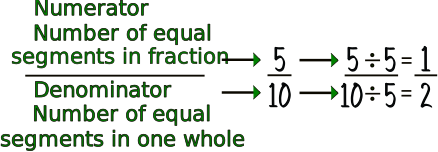
As you can see, the result of five tenths could be simplified because the numerator and the denominator could be divided by this common factor of 5. In this case, the largest common factor or the Greatest Common Divisor (GCD) is 5, so with that factor we were able to maximise our simplification of the answer .
In cases where more than the original fraction is subtracted and the result is a negative whole number or fraction, the answer is stated with a negative sign placed before either the whole fraction or the numerator or the denominator, as follows,
$$\frac{4}{7}-\frac{8}{7}=-\frac{4}{7}$$
In this case the negative sign was placed before the fraction, which is the standard convention, but you could place it before the numerator, which is 4, or the denominator, which is 7. As long as you only place one negative sign before the fraction.
Try the following exercises to complete this Class.
Show Answer
$$c)\; \frac{6}{6} $$
Show Answer
$$b)\; 1$$
Show Answer
$$d)\; \frac{24}{27} $$
Show Answer
$$a)\; Yes, to\; \frac{8}{9} $$
Show Answer
$$a)\; -\frac{4}{5} $$
Show Answer
d)\; The numerator and denominator do not share a common factor or GCD by which they can be divided.
Show Answer
$$c)\;-\frac{3}{2} $$
Show Answer
$$a)\; -1\frac{1}{2}$$
Show Answer
$$a)\; \frac{14}{8} $$
Show Answer
$$d)\;\frac{7}{4},1 \frac{3}{4}$$