
Understanding Fractions (First Fractions Classes 1.1 and 1.2)
Further Fractions (Classes 1.3 and 1.4)

Adding and Subtracting Fractions (Class 3.1 Final Fractions Class)
(Fractions Test for when Classes are completed)
Further Fractions 2
Fractions Class 2.1
Multiplying Fractions
It is easier to comprehend the concept of multiplying fractions with an illustration.
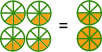
The equation indicated by the illustration above could look like this:
$$4 \;\times\;\frac{3}{8}=\frac{12}{8}\;=\;1\frac{4}{8}\;=\;1\frac{1}{2}\;(or\;\frac{3}{2})$$
The illustration above shows the four lots of three eighths as a group, and the three eighth sized portions are added in order to reach the result of one and four eighths. The results can be simplified to one and one half.
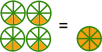
The next illustration (below) shows a multiplication of four eighths by eight eighths.

The equation indicated by the illustration could look like this:
$$\frac{4}{8} \;\times\;\frac{8}{8}\;=\;\frac{32}{64}=\;\frac{4}{8}\;or\;simplified\;\frac{1}{2}$$
This question is just asking you for one half of one, which, of course, is one half.
Multiplication of Fractions
A reliable method is used for multiplications of fractions,
The numerators are multiplied together to get the resultant numerator and denominators are multiplied together to get the resultant denominator. Then we look for common factors to see if we can simplify the answer. Here is an example:

To multiply a whole number with a fraction, we first express the whole number as a fraction by stating it as a numerator over 1, and then use the method outlined above to reach the final answer. Of course, once again, the last step is to simplify the answer, if it is possible. In the example below, our result was the improper fraction, twenty one eighths, which could then also be converted into the mixed number, two and five eighths:
$$3 \;\times\;\frac{7}{8}=\frac{3}{1} \;\times\;\frac{7}{8}=\frac{21}{8}$$$$\;or\;mixed\;number\;2\frac{5}{8}$$
To complete a fraction multiplication which involves a mixed number, we first convert the mixed number into an improper fraction and then proceed using the same method, as outlined above. Here is an example:
$$1\frac{2}{3} \;\times\;3\frac{4}{5}=\frac{5}{3} \;\times\;\frac{19}{5}=\frac{95}{15}$$$$\;simplified \;to\;\frac{19}{3}\;$$$$or\;mixed\;number\;6\frac{1}{3} $$
Try the following exercises to complete this class.
$$a)\;2 \;\times\;\frac{2}{8}=\frac{4}{8}\;or\;1$$ $$b)\;4 \;\times\;\frac{3}{8}=\frac{12}{8}$$ $$c)\;4 \;\times\;\frac{1}{8}=\frac{4}{8}\;or\;\frac{1}{2}$$ $$d)\;4 \;\times\;\frac{2}{8}=\frac{8}{8}\;or\;1$$
Show Answer
$$d)\;4 \;\times\;\frac{2}{8}=\frac{8}{8}\;or\;1$$
Show Answer
$$c)\;\frac{6}{5} $$
Show Answer
$$a)\;\frac{6}{20}=\frac{3}{10}$$
Show Answer
$$b)\;\frac{5}{48}$$
Show Answer
$$c)\;\frac{20}{8}=\frac{5}{2}$$
Show Answer
$$d)\;4\frac{1}{5}$$
Show Answer
$$d)\;8\frac{3}{4}$$
Show Answer
$$c)\;\frac{51}{20}$$
Show Answer
$$b)\;\frac{60}{35}=\frac{12}{7}$$
Fractions Class 2.2
Dividing Fractions
If you have made it this far through the fractions classes, congratulations!
To really understand the concept of what we are doing when we are dividing fractions, look at the following simple illustration,

We could say that the essence of the question in the above illustration is, how many twos are in the initial number, four, or if you simplify it, how many halves are in one. Of course the answer is 2. In fractions, the above illustration could be stated to this:
$$\frac{4}{4} \;\div\;\frac{2}{4}=\frac{4}{2}=\frac{2}{1}=2$$
In contrast, a multiplication with the same terms would look like this,
$$\frac{4}{4} \;\times\;\frac{2}{4}=\frac{8}{16}=\frac{1}{2}$$
In the multiplication, we multiplied the second term by the first, and in the division, we looked to find out how many of the second term were in the first, which represents a perfect inversion of the concept of multiplication.
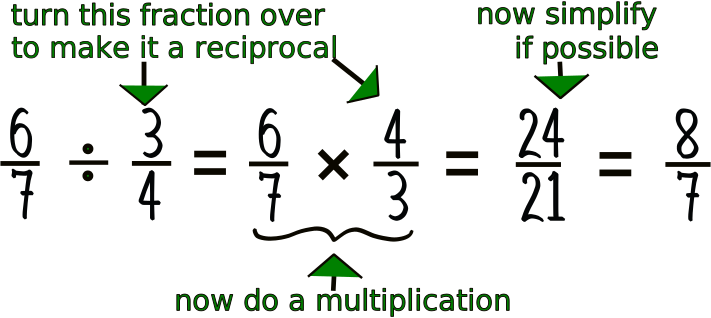
That is why the method we use for the division of fractions is the same as that used for multiplication, except that we invert the second term before we multiply it, as follows;
Divisions with Improper Fractions and Whole Numbers
To use the same method in a division which includes a whole number, we first convert the whole number into a fraction by stating it as a numerator over 1, and then use the method outlined above to reach the final answer. As always, the final step will involve simplifying the answer, if possible. Here is an example:
$$\frac{1}{2} \;\div\;4=\frac{1}{2}\;\div \;\frac{4}{1}=\frac{1}{2} \;\times\;\frac{1}{4}=\frac{1}{8}$$
Whether the whole number appears as the first term or as a later term in the division, the process is still the same.
To complete a fraction division which involves a mixed number, we first convert the mixed number into an improper fraction and then proceed using the method outlined above. Here is an example:
$$2\frac{3}{4} \;\div\;\frac{1}{8}=\frac{11}{4} \;\div\;\frac{1}{8}$$$$=\frac{11}{4} \;\times\;\frac{8}{1}=\frac{88}{4}\;$$$$or\;simplified\;\frac{22}{1} or \;22$$
Try the following exercises to complete this class.
$$a)\;\frac{8}{8}\;\div\;\frac{3}{9}=$$ $$b)\;\frac{9}{9}\;\div\;\frac{3}{9}=$$ $$c)\;\frac{1}{9}\;\div\;\frac{3}{9}=$$ $$d)\;\frac{9}{1}\;\div\;\frac{3}{1}=$$
Show Answer
$$b)\;\frac{9}{9}\;\div\;\frac{3}{9}=$$

Show Answer
$$a)\; 7\frac{2}{5} $$
Show Answer
$$c)\;6\frac{3}{4} $$
Show Answer
$$d)\;\frac{16}{15}$$
Show Answer
$$c)\;\frac{30}{44}=\frac{15}{22}$$
Show Answer
$$a)\;4\frac{3}{4}$$
Show Answer
$$b)\;8\frac{1}{3}$$
Show Answer
$$b)\;\frac{88}{10}\;=\;\frac{44}{5}$$
Show Answer
$$c)\;\frac{77}{15}=5\frac{2}{15}$$
Show Answer
$$b)\;\frac{27}{20}=1\frac{7}{20}$$