
Comprehension

After answering, use, ‘Show Answer.’ to reveal the answers.*
Comprehension – Two Comprehension Question Sets
(Ten Questions Each) Grades 8–10
Excerpts are from THE GIFT OF SONG
by Dame Nellie Melba, from the book*
WITH PRACTICAL ADVICE ON VOICE CULTURE.
By MADAME MELBA.
Excerpt One (With Questions and Answers Included)
1) Read the excerpt. 2) Answer the comprehension questions.
“During the years immediately preceding my first and, for me, my most memorable visit to Europe, the late Marquis of Normanby was Governor of Victoria. At that time I was regarded in Melbourne as a very good amateur pianist, much in request for private parties, at which I always played, and on very rare occasions also sang. At one of these functions, given at Government House, I gave some songs between the pianoforte selections, and the Marchioness of Normanby, in thanking me, said, “Child, some day you will give up the piano for singing, and then you will become famous.”
That was the simple comment that set me seriously thinking of a career as a singer. I had always felt that I would become a professional in music—pianist, organist, violinist, perhaps, but something in music, at any rate; but from that moment I knew in an irresistible way that I was to be a singer.
That remark of the Marchioness made me understand, and determined me to grasp “the skirts of happy chance.” I courted every semblance of opportunity, and I see now, as then, how fateful a factor opportunity must be with all who aim at a public career. Even the born singer may waste divine gifts for want of opportunity, and the possessor of highly developed vocal talent may entirely sink into obscurity without it.
Among students of similar talent and health she who succeeds is the one with alert mind, who is ever on the qui vive for her chance. The girl who fails is generally lacking in mental and physical energy—too prone to believe that opportunity on ready foot trips unsought even to the laggard’s door. The born or inspired singer always sings, although in isolated cases want of opportunity may limit the sphere of those rarely endowed people.
While it is true that the present time offers extraordinary scope for art by reason of a wide-spread knowledge on all subjects, I think the increased chances of success which the growing popularity of music offers have been largely discounted by the numbers of performers and professors who, without proper qualifications have set themselves up as apostles of music, and unfairly and recklessly overcrowded a profession which should be exceptionally difficult to enter.
No doubt many aspirants—I speak solely of women—are encouraged and flattered by the fact that in the profession of music women fare better than in any other walk of life, and the monetary reward of great singers and teachers may be said to have reached a stage of almost extravagant appreciation.”
Comprehension Questions
- At the beginning of the excerpt, the author, Dame Nellie Melba, indicates that soon after the events she described, she was then to go on a journey. Which one of the following did she indicate? a) She was soon to catch a bus and go to Melbourne. b) She was to travel around Australia in a round of concerts. c) She was soon to go to New Zealand to perform in Auckland. d) She was soon to go to Europe for the first time, in what would be her most memorable visit there.
Show Answer
d) She was soon to go to Europe for the first time, in what would be her most memorable visit there. - After reading this excerpt, what do you think was a major factor in causing Dame Nellie Melba to decide to become a singer? a) She was inspired by the example of others. b) She was encouraged to become a singer. c) She had only ever studied singing. d). Her Uncle told her she could sing.
Show Answer
b) She was encouraged to become a singer. - Dame Nellie Melba indicated that one may become a successful singer through which of the following? a) Talent alone. b) A combination of talent and money. c) A combination of talent and opportunity. d) Chance alone.
Show Answer
c) A combination of talent and opportunity.
- Dame Nellie Melba stated that one may only succeed if one has which of the following? a) A music degree. b) A certain nonchalance. c) A great deal of exposure to music and feedback. d) A certain mental and physical energy and an alert mind.
Show Answer
d) A certain mental and physical energy and an alert mind.
- If you could sum up the most positive thing Dame Nellie Melba was trying to say in this excerpt with one statement, which of the following would it be? a) Words are so powerful that even one encouraging statement can change a person’s life. b) Female musicians are capable of great things. c) A musician who is an all-rounder can be successful in any musical profession they feel drawn to. d) Do not give up on singing, even if you do not particularly feel you are gifted in it.
Show Answer
a) Words are so powerful that even one encouraging statement can change a person’s life.
- From what you have read in this excerpt, how would you describe the author’s view of life and talent? a) Determination is the main thing required to achieve everything you want in life. If you have that you can achieve anything. b) Follow your intuition, ignore your defects, and make sure your have enough financial support and then everything else will work out. c) A combination of being willing to take opportunities along with an ability to follow intuition and the counsel of others is a good approach. d) Even if you have the talent you do not have to be a singer. Do what you want to do, not what you have the talent for.
Show Answer
c) A combination of being willing to take opportunities along with an ability to follow intuition and the counsel of others is a good approach.
- How much knowledge did the author think was available at the time this excerpt was written? a) At the time it was written there was an abundance of knowledge on all subjects available. b) There was some knowledge available, but much of it was either misleading or untrue. c) There was little knowledge available though there were a lot of people with potential talent who could have done better with better teachers. d) There was too little knowledge available and too few people with talent.
Show Answer
a) At the time it was written there was an abundance of knowledge on all subjects available.
- According to the author the popularity of music was…a) Declining. b) Plateauing. c) Soon to increase. d) Growing.
Show Answer
d) Growing.
- Regarding performance and teaching, Dame Nellie Melba thinks that… a) There should be more music teachers and less musicians who are not capable of performing. b) There should be more stringent requirements put upon the admission of those who teach and perform music into their respective fields. c) The number of teachers should be reduced and there should be an increase in students who aspire to become famous performers. d) There should be more positivity towards music as a whole, as lately a wave of negativity has beset the industry.
Show Answer
b) There should be more stringent requirements put upon the admission of those who teach and perform music into their respective fields.
- Which of the following best describes the overall sentiment of the last two paragraphs of this excerpt? a) With the popularity of music surging, everyone who aspires to be a musician should take the opportunities presented to them to become one. b) With so much obvious demand for musicians and teachers, individuals with leanings in those directions should follow their inclinations with optimism. c) The repertoire of a musician should reflect the wishes and tastes of his audience alone. d) Those who are seeking to become musicians should question if they are genuinely talented or if they are just seeking the applause and flattery of others and to ride the current wave of popularity in music.
Show Answer
d) Those who are seeking to become musicians should question if they are genuinely talented or if they are just seeking the applause and flattery of others and to ride the current wave of popularity in music.
Excerpt Two (With Questions and Answers Included)
1) Read the excerpt. 2) Answer the comprehension questions.
“In my opinion the great singers of our day would not be so few if there were more competent teachers and a more complete realisation of the greatness of the task. It is not that lovely voices are rarer than formerly, or talent more sparingly given of God. The piano or violin student will devote ten years to the technique of his instrument, while the vocalist or the teacher too often regards research at an end after studying a year or two, or even a few months only.
Just here, however, I should like to make it plain that the student who cannot give a promising account of herself after eighteen months’ thorough study is, to my mind, never likely to do really great things. I do not mean for a moment that she should then be a full-fledged singer, but that she should be able to give clear indications as to future possibilities.
The real study actually begins after one has come before the public, and it is to subsequent development that the most earnest attention should be paid. Year after year the artiste will make striking progress if music be really in her soul, and from life and its varied experiences she will learn interpretative nuances which no other teacher can bestow. Let me say, too, that in this life-long study the singer must not be too rigidly bound by the tenets of technique. She must think and feel for herself, and to a great extent be guided by her individuality.
In too many cases the vocal student has only the merest smattering of knowledge about the marvellous and delicate mechanism that produces the singing voice. Languages and travel, too, are neglected for one reason or another, chiefly through the spirit of haste, the desire to reach ends by short cuts such as were unknown to the old Italian masters, who taught on physiological principles that were, on the whole, marvellously accurate; although in many respects we have greatly progressed since their day.”
Comprehension Questions
- In the first paragraph of the excerpt, the author, Dame Nellie Melba, states which two of the following ideas? (Here there are two correct answers to select). a) There are too many teachers who do not truly master the art of teaching the piano. b) Even though there are just as many naturally talented singers around as there ever were, teachers of singing need to persist in teaching the technique of singing for years rather than for months. c) As there are not as many naturally gifted singers, teachers will have to teach only the talented students. d) Pianists and violinists often have much more knowledge of the technique of their instruments than singers.
Show Answer
b) Even though there are just as many naturally talented singers around as there ever were, teachers of singing need to persist in teaching the technique of singing for years rather than for months. and d) Pianists and violinists often have much more knowledge of the technique of their instruments than singers. - What do you think Dame Nellie Melba was trying to say in the first two paragraphs of this excerpt? a) Students who aspire to become performers should attend singing concerts as much as possible in the first 18 months of their tuition. b) Students of violin, piano and singing need to devote more time to practising performing by attending events like eisteddfods and other competitions. c) Teachers of singing students should devote more time to training their students in theory and historical background of singing. d). Study of the technique of singing is the one thing required as a prerequisite for someone to have the potential to become a truly accomplished singer. Therefore study should not be neglected by either teachers or students.
Show Answer
d). Study of the technique of singing is the one thing required as a prerequisite for someone to have the potential to become a truly accomplished singer. Therefore study should not be neglected by either teachers or students.
- How would you regard the assertion that in this excerpt Dame Nellie Melba claims that one may become an accomplished singer even without the attainment of knowledge and ability in proper technique. Is this true or false? a) True. b) False.
Show Answer
b) False
- From what you have read in this excerpt, Dame Nellie Melba believes that study really begins and accelerates after which of the following? a) When the student begins performing. b) When the student first aspires to become a performer. c) After the student begins their training with an expert teacher. d) When the student begins their tertiary degree.
Show Answer
a) When the student begins performing.
- In this excerpt, the author indicates that the singer’s personal life experiences can contribute to their singing ability. How? a) Life experience gives them added confidence, thus giving them more confidence when they sing. b) Over time, life experiences give them understanding and interpretative nuances which no other teacher can bestow. c) A broader outlook is attained through life experiences, and that helps their voices to mature. d) A person’s voice matures as time goes on.
Show Answer
b) Over time, life experiences give them understanding and interpretative nuances which no other teacher can bestow.
- From what you have read in this excerpt, the author’s view of study and learning are that they are which of the following? a) Automatic. b) Unnecessary after a while. c) Something one must rigidly adhere to. d) Lifelong.
Show Answer
d) Lifelong.
- According to the author, ideally, good technique is to be tempered by which of the following? a) One’s own personal biases and beliefs. b) Perspective. c) A zeal for life. d) One’s own individual tendencies.
Show Answer
d) One’s own individual tendencies.
- According to the author, which of the following is true regarding most singers? a) They do not even understand their own voice box. b) They have difficulty because they have failed to do enough vocal exercises. c) They do not sing a varied and interesting repertoire. d) They do not believe in themselves enough.
Show Answer
a) They do not even understand their own voice box.
- In the final paragraph of this excerpt, the author is saying which of the following things? a) There are too many singers who try to perform before they have done the theory. b) Violin and piano teachers have not been diligent enough in passing on their knowledge to their students. c) Singers are taking too many shortcuts and not attending to the finer details of study and technique. d) There should be more singers who see music as an art form, and not as a part of a larger picture but as an end in itself.
Show Answer
c) Singers are taking too many shortcuts and not attending to the finer details of study and technique.
- Which of the following best summarises the overall message of the excerpt? a) There are many who would be accomplished singers if it were not for their failure to do exercises prior to each singing lesson. b) Music venues are full of musicians who have no real talent. c) There are many who could potentially become truly accomplished singers if they actually took the time to understand and practise proper vocal technique and the principles of the physiology of singing, and to improve their singing through performances, exposure to other languages and travel. d) Those who are seeking to become accomplished singers should first study the old Italian Masters, who represent the pinnacle of the art form, and then should seek to hone their skills through exposure to other languages and countries.
Show Answer
c) There are many who could potentially become truly accomplished singers if they actually took the time to understand and practise proper vocal technique and the principles of the physiology of singing, and to improve their singing through performances, exposure to other languages and travel.
Learn more about Dame Nellie Melba
Dame Nellie Melba
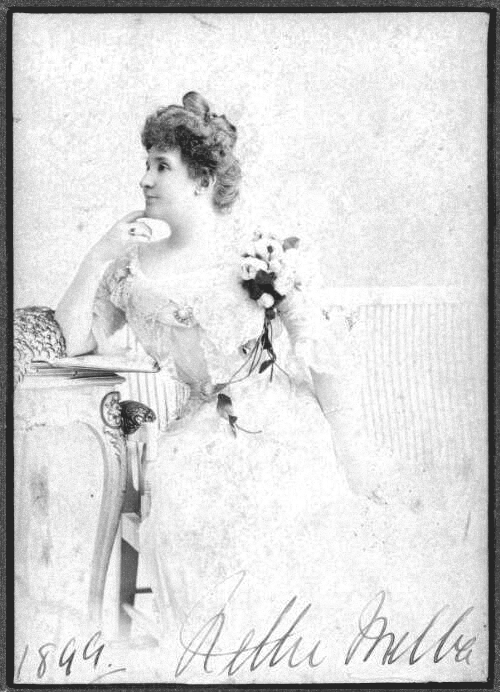
Dame Nellie Melba (1861-1931), born in Richmond, Melbourne, Australia, was a coloratura soprano, a singer who was much loved by many around the world and in Australia. Throughout her schooling in Australia and further development as a singer whilst performing in Europe, she was blessed with a succession of good teachers who encouraged her and helped to foster her talent. She gave many fine performances in Europe and Australia, and went on to become one of the most popular singers in the late 19th and early 20th centuries in Australia and in the world. Born with the name Helen Porter Mitchell, she later changed it to be Melba, after her hometown, Melbourne.
*p7-9, Madame Clara Butt, Madame Melba, Signor Caruso, Mr. Ben Davies, How to Become a Successful Singer, LONDON: GEORGE NEWNES, LIMITED, SOUTHAMPTON STREET, STRAND, W.C., Early 20th century
(*All Public Domain Excerpts.)