Practical Learning Activity
Skills

Practical
Take notes and answer questions as you read and learn.
Introduction to Variables and Functions
(See page on Polynomials) (see page on Algebra)
(Go Straight to the Variables and Functions Quiz)
(Go to Index Laws for Algebra)
What are Variables?
Mathematical phrases and sentences can contain unknown values, as well as known values. The unknown values can be represented with variables like x and y. Algebraic methods are used to preserve the mathematical integrity of equations, while transforming them, in order to find the missing values of the variables. This usually involves isolating variables so that they can be compared to known values within equations. (See page on Algebra).
A coefficient is a number or a symbol that represents a constant value that is multiplied by the variable of a single term or the terms of a polynomial. For instance, the coefficient of the term 5x is 5. Whenever a variable has a coefficient, there is an implied multiplication of the variable by its coefficient. Indeed, any two adjacent symbols which represent a value, whether they be variables or numbers, are multiplied. For instance,$$4x\;=\;16\;means\;$$$$4\;×\;x\;=\;16$$If you have only 1 as the coefficient of x the term is written as x.
Equations with Variables
In an expression or equation, the value for x remains the same. For example, if x = 4 in the following equation,
$$4x\; + \;x \;=\; 20$$ x has the same value both times it appears. If a different missing value were to be added to the equation, it would be described with a different variable name, like y, a or b. For example, when $$x\;=\;4$$ in the equation, $$4x\; +\; x \;+ \;y \;= \;25$$
y would be assigned a different value than x. In this example, y = 5.
Examples of Unknown Values of Variables Being Found
The following is an example of an equation with a variable in it, which is x. The number beside x is the coefficient. This equation provides you with enough information to find the value of x.
$$3x\;=\;30$$
To get the answer, all you have to do is to work out which number is multiplied by three to make thirty. Did you think of it?
See Answer
$$x\;=\;10$$
Here is another equation for you to solve. See if you can work out the value of y in the equation,
$$7y\;=\;28$$
There is only one answer to this equation. It is a number which is multiplied seven times to get the answer of 28. Did you think of it?
See Answer
$$y\;=\;4$$
A good way to find this answer algebraically is to isolate the y by moving the 7 to the other side of the equation and reversing the multiplication operation to division, as is shown here,$$7y\;=\;28$$$$y\;=\;28\;÷\;7$$$$y\;=\;4$$
Now Try These
$$5x\;=\;25$$
See Answer
$$x\;=\;5$$
$$2y\;=\;12$$
See Answer
$$y\;=\;6$$
$$7x\;+5x\;=\;12$$
See Answer
$$12x\;=\;12$$$$x\;=\;1$$
$$10\;+2x\;=\;14$$
See Answer
$$2x\;=\;14\;-\;10$$$$2x\;=\;4\;$$$$x\;=\;2\;$$
What about Equations That Have More than One Variable?
An equation with one variable may be easy enough to solve, as long as you have been provided with enough information. However, a single variable presented with one coefficient, such as 2x, without the presence of further information, can have an infinite number of solutions. Where you have two or more variables, a lack of known values can mean that you will find no specific solutions. While the ratio between the variables would always remain the same, any number of value combinations could be valid.
A problem like,
$$10y \;- \;8x\;=?$$
cannot be solved, because it contains two unknown variables, and not enough information. No further simplification or solution can be made until and if more information is given.
However, it is often the case that we are given all of the clues we need to solve variable problems using regular algebraic methods.
Functions
In the case of functions, there are usually two variables, x and y, and the infinite pairs of solutions are used to create all sorts of graphs. Where the order of two elements is arranged in a particular way, as is the case with (x, y) coordinates, the two elements are known as an, ‘ordered pair.’ In coordinate geometry, (x, y) is considered an ordered pair, because x will always precede y. (x, y) coordinate pair values can be graphed with the Cartesian coordinate system, on a Cartesian plane, which has a horizontal x axis and a vertical y axis. The first number, x, will tell you how far to go to the left or right along the x axis, and the second value, y, will tell you how high or low to go on the y axis. (3, 7) and (7, 3) will be at very different locations on the Cartesian plane because the order of coordinates is always (x, y).
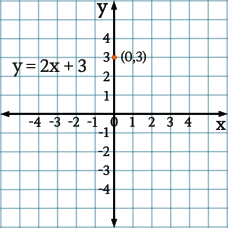
The following illustration is of a Cartesian plane. We can see the horizontal x axis and the vertical y axis. With the linear equation, y = 2x + 3, when we make x = 0 in the equation, y is found to equal 3. This calculation makes the ordered pair (0, 3), which are the (x, y) coordinates, and you can see that point has been plotted on the coordinate plane.
Adding and Subtracting Different Numbers of the Same Variable
An expression is a mathematical phrase which has no equals sign. You are not usually able to solve an expression, such as,$$4b\;+\;2b\;$$but you may be able to simplify it. For instance, you can add and subtract any amount of the same variable freely within the one expression in order to simplify it. Some examples are,
Example One:
$$4x\;+ \;3x \;$$$$simplified \; by\;combining \;$$
$$like \;terms\; is$$
$$ \;7x\;$$
Example Two:
$$3x\;+\;x\;$$$$simplified \; by\;combining \;$$
$$like \;terms\; is$$$$4x$$
Example Three:
$$\;10y\; – \;8y\;$$$$simplified \; by\;combining \;$$
$$like \;terms\; is$$$$2y$$
As you can see in the examples above, the rule with addition and subtraction is that when adding or subtracting the same variable, the coefficient number before the variable gets added or subtracted, while the variable remains the same.
Simplify the following expressions
Show Answer
$$11x$$
Show Answer
$$\;8x$$
Show Answer
$$\;14x$$
Show Answer
$$\;15x$$
Show Answer
$$\;6a\;+\;5x\;$$
Multiplying and Dividing Different Numbers of the Same Variables
In expressions, you can also multiply and divide any amount of the same variable freely. For instance, the expression
$$10x\;÷\;2x\;$$$$simplified \; is\;$$$$5\; $$
The expression
$$5x\;×\;x\;$$$$simplified \; is\;$$$$5x^2\; $$
The expression
$$2x\;×\;3x^2\;$$$$simplified \;is,$$$$6x^3\; $$
The expression
$$9x^5\;÷\;3x^3\;$$$$simplified\; is,$$$$3x^2\; $$
As you can see in the examples above, the rule with multiplying and dividing is that when multiplying or dividing by the same variable, the coefficient number before the variable gets multiplied or divided, and the variable takes on a different power or exponent. With multiplication the exponents of the two variables which are multiplied are added, and with division the second exponent is subtracted from the first. (See Page on Index Laws)
Simplify the following expressions
Show Answer
$$4x^4$$
Show Answer
$$15x^5$$
Show Answer
$$4a^3$$
Show Answer
$$4x^2$$
Show Answer
$$3$$
Examples of Solving Variables by Reversing the Operations in Addition and Subtraction
When there is just one variable in an equation, it is often possible to find a solution. For instance,
$$x\; + \;10\; = \;12$$
To find the value of x in the above equation we isolate the variable, x, by moving, 10, across from the left to the right side of the equation. We change the sign of 10 from positive to negative to balance out the equation.
$$x\;= \;12 \;-\;10\;$$
From that we can deduce that,
$$x\;= \;2\; $$
Answer a similar question here
Show Answer
$$x\; + \;15\; = \;30$$$$\;x\; = \;30\;-\;15$$$$x\; = \;15$$
Examples of Solving Variables by Reversing the Operations in Multiplication and Division
$$5x\; +\;2\;= \;17\; $$
To find the value of x in this equation we isolate the term, 5x, by moving the 2 across from the left to the right side of the equation. We change the sign of 2 from positive to negative to balance out the equation.
$$5x\; = \;17\; -\;2$$
$$\;5x\; = \;15$$
You will recall that there is an implied multiplication between any coefficient and its variable. To find the value of x in this equation we isolate the variable, x, by moving the coefficient, 5, across from the left to the right side of the equation. At the same time we change the sign of the operation from multiplication to division to balance out the equation, and then find the solution as shown here,
$$x\; = \;15 ÷ 5\;$$ and the solution is $$x\;=\;3 $$
Answer a similar question here
Show Answer
$$4x\; + \;3\; = \;19$$$$\;4x\; = \;19\;-\;3$$$$\;4x\; = \;16$$$$x\;=\;16\;÷\;4 $$$$x\; = \;4$$
What are Functions?
An example of a function would be an equation that has two variables, x and y, and we input the value for x to receive the output value of y. For instance, a line can be graphed by inputting different values for x into a linear equation, to receive the y coordinates as output. As a function, the equation works like a machine to generate new values for y from all of the x inputs we put into it, thus giving us the ordered pairs or (x, y) coordinates for the line that will be plotted on a Cartesian plane.
Example of a Function
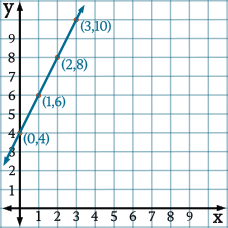
An example of a function would be where we use a linear equation as a function and input certain values of x to get certain values of y as outputs and then plot the coordinates on a Cartesian plane. For instance, the following linear equation,
$$y\; = \;2x\;+\; 4\; $$
$$is\; transformed \;into$$$$ the \;function,$$
$$f(x)\; = \;2x\;+\; 4\; $$
f(0) means you are getting the y value when x is equal to 0 in the function,
$$f(0)\; = \;2(0)\;+\; 4$$thus the value of the function when x = 0 is 4 and,$$y\;= \;4\;$$$$and\; the\; (x, y) $$
$$coordinates\; are\; (0, 4)$$
f(1) means you are getting the y value when x is equal to 1 in the function,
$$f(1)\; = \;2(1)\;+\; 4$$thus the value of the function when x = 1 is 6, and,$$y\;= \;6$$$$and \;the\; (x, y) $$$$coordinates \;are\; (1, 6)$$
To get the y value when x is equal to 2,
$$f(2)\; = \;2(2)\;+\; 4 $$thus the value of the function when x =2 is 8 and,$$ y\;= \;8\;$$$$and\; the\; (x, y) $$$$coordinates\; are \;(2, 8)$$
to get the y value when x is equal to 3,
$$f(3)\; = \;2(3)\;+\; 4$$thus the value of the function when x =3 is 10, and,$$ y\;= \;10\;$$$$and\; the\; (x, y) $$$$coordinates \;are\; (3, 10)$$
You can see that where x is 0, 1, 2 and 3 we receive the following (x, y) pairs of values: (0, 4)(1, 6)(2, 8) and (3, 10). These can be plotted on a Cartesian plane and used to make the following graph,