
Practical Learning Activity
Skills

Practical
Take notes and answer questions as you read and learn.
(See page on Linear Equations)
Introduction to Solving Linear Equations
Solving a Linear Equation For x
$$6x\; -\; 3 \; =\; 9$$
Here we are trying to isolate x in order to find the value for x, which is an algebraic method (see page on Algebra). We see that if a value minus three equals nine, it must also be the case that three and nine added together will give the same value, which in this case is equal to 6x. So we move 3 from the left side of the equation to the right side and reverse the sign from minus to plus to get the following,
$$6x\; =\; 9\;+\;3\; $$$$6x\; =12$$
To further isolate x we have to try to put the coefficient, 6, onto the right side of the equation. It makes sense that if six times a certain number gave us twelve, then twelve divided by 6 will give us the value of that number. So we move the 6 to the other side of the equation and reverse the sign from multiply to divide, as follows,
$$\;6x\; =\;12\; $$$$x\; =\;\frac{12}{6}\;$$
An equivalent way of writing this fraction would be,
$$x\; =\;12\; ÷\;6\;$$
This is a different way of doing the same thing, and it will give you the same solution.
We know that there are two sixes in twelve so the answer is,
$$\;x\; =\;2\;$$
See if you can solve the following similar linear equations for x.
Show Answer
$$4x\;=\;10\;+\;6$$$$4x\;=\;16$$$$x\; =\;\frac{16}{4}\;$$$$x\; =\;4\;$$
Show Answer
$$3x\;=\;10\;+\;5$$$$3x\;=\;15$$$$x\; =\;\frac{15}{3}\;$$$$x\; =\;5\;$$
Show Answer
$$2x\;=\;20\;-\;6$$$$2x\;=\;14$$$$x\; =\;\frac{14}{2}\;$$$$\;x\; =\;7\;$$
Show Answer
$$4x\;=\;21\;-\;9$$$$4x\;=\;12$$$$x\; =\;\frac{12}{4}\;$$$$\;x\; =\;3\;$$
Show Answer
$$5x\;=\;12\;-\;2$$$$5x\;=\;10$$$$x\; =\;\frac{10}{5}\;$$$$\;x\; =\;2\;$$
Solving a Linear Equation Which Has Two Variables
A linear equation has no exponent higher than 1, and with one variable usually has only one singular solution. However a linear equation with two variables can have an infinite number of solutions which are in pairs. If we call one variable x, for numbers going horizontally, and one variable y, for numbers going vertically, we can make the equation come to life on the Cartesian plane, as shown below. Because there are two values, the values are flexible, but with each x and y pair the value of y is dependent on the value of x. For each value of x there will be a specific value of y which will be provable within the same equation, when the value of x is substituted into the equation. An example of how pairs from a linear equation can be pictorially represented on a Cartesian plane is shown below. The same linear equation can be used to generate all the points that will make a line such as this. For each new equation, we only need two such pairs to draw a line, since we know that the line will be straight .
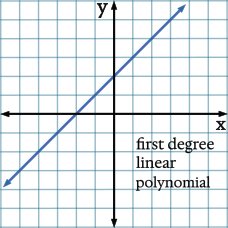
The solutions to a linear equation depends on the point you are looking for.
Finding an Intercept
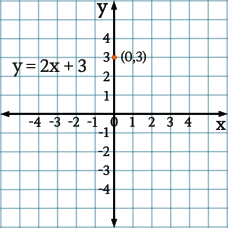
To find a line’s x-intercept, we have to find the value of x when y equals zero, because y equals zero at all of the points along the x-axis. Similarly, to find a line’s y-intercept, we have to find the value of y when x equals zero, because x equals zero at all of the points along the y-axis. To find the y-intercept of the line made by the following equation, we will make x equal to zero and substitute that into the equation. The linear equation is,
$$\;y\; =\;2x\;+\;3\; $$$$\; where\;x\; = \;0$$$$ \;y \;=\; 2(0)\; + \;3\;$$$$\; y \;=\; 0 \;+\; 3\;$$$$\;y \;=\;3$$
This gives us the (x, y) coordinates of (0, 3) for the point where the line generated by this equation crosses the y-axis.
Finding an Intercept
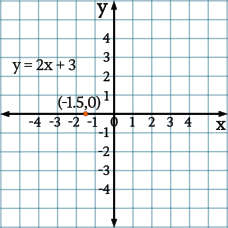
To find a line’s x-intercept, we have to find the value of x when y equals zero. So we make y equal to zero and substitute that into the equation to find the answer, as shown here,
$$\;y\; =\;2x\;+\;3\; $$$$\;where \;y\; = \;0 $$$$\;0\;=\; 2x\; + \;3 \;$$$$\; 2x \;= \;-\; 3 \;$$$$\ x \;=-\frac{3}{2}$$
This give us the (x, y) coordinates of (-1.5, 0) for the point where the line generated by this equation crosses the x-axis.
Plotting Points to Draw a Line on a Cartesian Plane
A linear equation should be made into the form y = mx + c, which is called the slope-intercept form, before it is used as a function (See page on Variables and Functions) and plotted on a Cartesian plane. In the equation, y = mx + c, m is the slope of the line and c is the y-intercept. This format enables you to more easily find a value for y when you input a value for x, because the y value has been isolated.
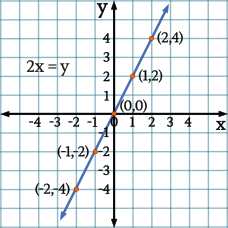
If you wish to plot the points of a linear equation on the Cartesian plane, you may use a table like the one shown here, to make the (x, y) coordinates you will need. The x and y values are found by substituting any value for x into the equation. The following values are derived from the linear equation,
$$ y\;= \;2x\;$$
| variables | pair | pair | pair | pair | pair |
|---|---|---|---|---|---|
| x value | -2 | -1 | 0 | 1 | 2 |
| y value | -4 | -2 | 0 | 2 | 4 |
By substituting different values for x into the equation we have found the value of y in each case. We have found the value of y when x = -2, -1, 0, 1, and 2. We now have the (x, y) coordinates of points which we can plot on a Cartesian plane. We can then draw a line that passes through those points. When making such a graph from a linear equation, we actually only need two pairs of coordinates, because with just two points we can draw a line.
Activity
With each of the following equations, make a table like the one shown above and find the value of y where the value of x is -2,-1, 0, 1 and 2. Plot the points you have found on a Cartesian plane with the coordinate pairs shown in (x, y) format next to each point. With a ruler, draw a line through the points, and write the linear equation next to or underneath each graph. Your graphs should look like the one shown above, but with different coordinates, when finished. After you have made these graphs, you will also be able to see how the different values for the coefficients of x and constants in each linear equation changed the slope and position of each of the lines you graphed.
Show Answer
| variables | pair | pair | pair | pair | pair |
|---|---|---|---|---|---|
| x value | -2 | -1 | 0 | 1 | 2 |
| y value | -5 | -3 | -1 | 1 | 3 |
Show Answer
| variables | pair | pair | pair | pair | pair |
|---|---|---|---|---|---|
| x value | -2 | -1 | 0 | 1 | 2 |
| y value | 0 | 1 | 2 | 3 | 4 |
Show Answer
| variables | pair | pair | pair | pair | pair |
|---|---|---|---|---|---|
| x value | -2 | -1 | 0 | 1 | 2 |
| y value | -5 | -4 | -3 | -2 | -1 |
Show Answer
| variables | pair | pair | pair | pair | pair |
|---|---|---|---|---|---|
| x value | -2 | -1 | 0 | 1 | 2 |
| y value | -8 | -6 | -4 | -2 | 0 |
Show Answer
| variables | pair | pair | pair | pair | pair |
|---|---|---|---|---|---|
| x value | -2 | -1 | 0 | 1 | 2 |
| y value | 3 | 4 | 5 | 6 | 7 |
Solving Simultaneous Equations
An equation with more than one variable can have an infinite number of solutions. Simultaneous equations are two equations which share the same unknown values of x and y, and thus a definite solution which may be found by solving the equations for variables at the same time. When we graph simultaneous equations we find that the solution to x and y are the coordinates for the location of where the two lines generated by the equations cross over. There will, of course, be no crossing point, or specific solutions, if both of the lines are perfectly parallel. One way to find the crossing point is to accurately graph the two lines on a Cartesian plane. Another more accurate method is to simultaneously algebraically solve the two equations.
For example, given the following two equations, the first step will be to isolate y in both equations.
$$Equation\; 1:\;y\; -\;2\;=\;x\; $$$$Equation \;2:\;y\;+\;1\; =\;4x\;$$
$$Equation\; 1:\;y\;=\;x\;+\;2 $$$$Equation \;2:\;y\; =\;4x\;-\;1$$
The second step will be to make the sides of the equations that y is equal to, equal to each other.
$$\;x\;+\;2\;=\;4x\;-\;1$$
Then, by subtracting x from both sides we get,
$$\;2\;=\;3x\;-\;1$$
Then, by adding one to both sides we get,
$$\;3\;=\;3x$$
and our answer is,
$$\;1\; = \;x\;$$or, to state more correctly,$$ x = 1$$
thus giving us the x coordinate of 1 for the crossing point of the two lines. To find the y coordinate of the crossing point of the two lines all we have to do is substitute the known value of x, which is 1, into either of the original equations as follows,
$$Equation\; 1:\;y\; -\;2\;=\;x$$
$$\;y\; -\;2\;=\;1$$
$$\;y\; =\;1\;+\;2$$
$$\;y\; =\;3$$
We can see, y = 3. Therefore the coordinates of the crossing point of the two lines are (1, 3) as shown in the graph below.
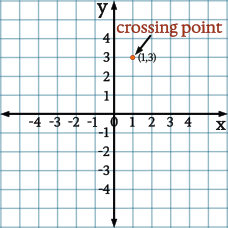
See if you can solve the following simultaneous equations for x and y, and find the coordinates of the crossing point of the two lines graphed from these equations.
Show Answer
$$Equation\; 1:\;y\;=\;10\;-\;3x $$$$Equation \;2:\;y\; =\;8\;-\;2x$$$$\;10\;-\;3x\;=\;8\;-\;2x\;$$$$10\;-\;x\;=\;8$$$$-\;x\;=\;8\;-\;10$$$$-x\;=\;-2$$$$x\;=\;2$$$$substituting \;2\;for\;x$$$$Equation\; 1:\;3x\; +\;y\;=\;10\; $$$$\;3(2)\; +\;y\;=\;10\;$$$$\;6\; +\;y\;=\;10\;$$$$\;y\;=\;10\;-\;6$$$$\;y\;=\;4$$$$Thus,\;the\;$$$$ coordinates\;of\;the$$$$crossing\;point\;are\;(2,\;4)$$