
Practical Learning Activity
Learn

Practical
Take notes and answer questions as you read and learn.
(see page on Solving Linear Equations)
Introduction to Linear Equations
What are Linear Equations?
A linear equation is a first degree polynomial,(see page on Polynomials) which includes a variable with its highest exponent being one. It is called first degree, and can also be known as a linear polynomial, because the graph of such a polynomial is linear, always forming a straight line, as shown below.
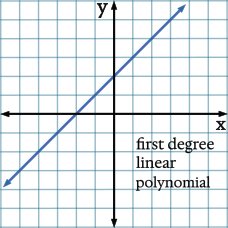
A linear equation can be written in the slope-intercept form or the gradient-intercept form of y = mx + c. x is the independent variable, and y is the dependent variable. The constant c, which is the number added to or subtracted from the coefficient and variable, shifts the line up or down, changing the points at which the line crosses the y-axis, without changing the slope of the line. Where the line is not vertical, the coefficient of x, which is m, determines the slope or angle of the line.
With reference to the slope-intercept form of a linear equation, to draw the graph of, $$y\;=\;2x\;+\;7$$ the gradient will be m or 2, and the y-intercept will occur at 7. The (x, y) coordinates for the y-intercept will be (0, 7). You can also graph a linear equation by making a table and finding the values of y where a number of values are substituted for x.
The slope of any line is defined by the following ratio:
$$slope\; = \;\frac{rise\; or\; change\; in\; y} {run\; or\;change\; in\; x}\;$$
For instance for the equation, $$y\;=\;2x\;+\;7$$where the gradient m is said to be 2. The integer 2 represented as a fraction is,$$\frac{2}{1}$$So a gradient of 2 means that every time the x value increases by one, the y value increases by 2.
Linear equations do not have any variables which are squared. A squared variable in an equation would cause the line to curve and ultimately distinctly turn at its central axis of symmetry, as we see in quadratic equations (see page on Quadratic Equations).
Examples of Linear Equations
The following are examples of linear equations:
$$y\;=\;2x\;+\;3$$
$$y\;=\;4x\;+\;1$$
When a linear equation is made into a graph, the x-intercept, can be found when y is equal to zero. This can be explained as follows. When you look at a Cartesian plane, y is equal to zero right along the entire x-axis. Therefore the x-intercept point of a line can be found by making the whole linear equation, or y, equal to zero. For example:
$$y\;=\;2x \;+ \;7 \; \;$$$$0\;=\; 2x \; + \;7 \; $$$$\;2x \; = \; -7$$
To find the solution, we use the algebraic method (see page on Algebra) of isolating x. The number, 2, must be transferred to the other side of the equation, and in the process, the operation has to be inverted from multiplication to division. So the number, 2, is now divided instead of being multiplied, as follows,
$$x\; = \; -\frac{7} {2} \; \;$$$$\; x\; =\; – 3\frac{1} {2}$$
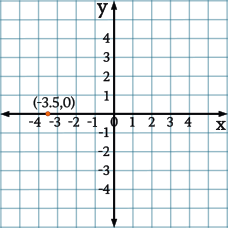
Therefore, the x-intercept point, where y is equal to zero, is minus three and a half. This means the (x, y) coordinates, where y equals zero, for this particular equation, are (-3.5, 0). We can plot that point on a plane as follows,
Solve the following equations to find the value of the x-intercept, where y = 0, and then state the coordinates or ordered pair where y = 0.
Show Answer
$$\;\;3x\;+\;6\;=\;0$$$$\;\;3x\;=\;-6$$$$\;\;x\;=\;-\frac{6}{3}$$$$x\;=\;-2$$$$Thus,\;the\;$$$$ coordinates\;are\;(-2,\;0)$$
Show Answer
$$\;\;5x\;-\;10\;=\;0$$$$\;\;5x\;=\;10$$$$\;x\;=\;\frac{10}{5}$$$$x\;=\;2$$$$Thus,\;the\;$$$$ coordinates\;are\;(2,\;0)$$
Show Answer
$$\;\;3x\;+\;12\;=\;0$$$$\;\;3x\;=\;-12$$$$\;\;x\;=\;-\frac{12}{3}$$$$x\;=\;-4$$$$Thus,\;the\;$$$$ coordinates\;are\;(-4,\;0)$$
Show Answer
$$\;\;4x\;-\;20\;=\;0$$$$\;\;4x\;=\;20$$$$\;\;x\;=\;\frac{20}{4}$$$$x\;=\;5$$$$Thus,\;the\;$$$$ coordinates\;are\;(5,\;0)$$
Show Answer
$$\;\;3x\;+\;8\;=\;0$$$$\;3x\;=\;-8$$$$\;\;x\;=\;-\frac{8}{3}$$$$x\;=\;-2\frac{2}{3}$$$$Thus,\;the\;$$$$ coordinates\;are\;(\;-2\frac{2}{3},\;0)$$
(see page on Variables and Functions)
Using a Linear Equation as a Function
Linear equations can be used as functions (see page on Variables and Functions) to graph lines. The y values can be found by substituting different values for x into the function. These (x, y) pairs then become the coordinates to plot on a Cartesian plane. To demonstrate this, we can first make an equation into a function,
$$y\; = \;2x,\;becomes,\;f(x)\;=\;2x\;$$
then calculate the y values by substituting values for x as follows,
$$f(x)\;= \;2x,$$
$$\;f(-2)\;= \;2(-2) \;$$$$y\;=\;-4$$which means the value of the function when x = -2 is -4.
$$f(-1)\;= \;2(-1)\;$$$$y\;=\;-2$$which means the value of the function when x = -1 is -2.
$$f(0)\;= \;2(0)\;$$$$y\;=\;0$$which means the value of the function when x = 0 is 0. And so on.
Jot down these values in a table to clearly see the coordinates which will be plotted on the Cartesian plane.
| variables | pair | pair | pair | pair | pair |
|---|---|---|---|---|---|
| x value | -2 | -1 | 0 | 1 | 2 |
| y value | -4 | -2 | 0 | 2 | 4 |
These coordinate pairs can then be plotted as follows,
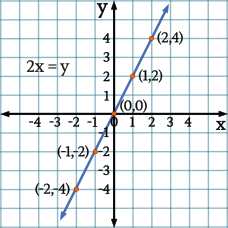
You can see that the first two values in the table above are the (x, y) coordinates (-2, -4) and they are marked as a point on the plane. The next set of (x, y) coordinates in the table are (-1 , -2) which are marked as another point on the plane, and so on. When enough points have been plotted, you can draw a line through the points, as shown above.
Various methods are used to solve linear equations. (See page on Solving Linear Equations)
Find the value of y in the following equations, and then state the coordinates or ordered pair
Show Answer
$$y\;=\;2(2)\;+\;2$$$$y\;=\;6$$$$Thus,\;the\;$$$$ coordinates\;are\;(2,\;6)$$
Show Answer
$$ y\; = \;3(5)\; – \;7$$$$ y\; = \;15\; – \;7$$$$y\;=\;8$$$$ Thus,\;the\;$$$$ coordinates\;are\;(5,\;8)$$
Show Answer
$$ y\; = \;4(-2)\; – \;3$$$$ y\; = \;-8\; – \;3$$$$y\;=\;-11$$$$ Thus,\;the\; $$$$coordinates\;are\;(-2,\;-11)$$
Show Answer
$$ y\; = \frac{1} {2}(4)\; – \;3$$$$ y\; = 2\; – \;3$$$$y\;=-\;1$$$$Thus,\;the\; $$$$ coordinates\;are\;(4,\;-1)$$
Show Answer
$$ y\; = \;2(7)\; + \;7$$$$ y\; = \;14\; + \;7$$$$y\;=\;21$$$$Thus,\;the\; $$$$ coordinates\;are\;(7,\;21)$$
Some Examples of Linear Equations in Action
A linear equation can be seen as a mathematical sentence where the relationship between variables is established. Most linear equations have two variables, though they can have more. Real life scenarios, where there are two variables, can be perceived from a mathematical point of view as linear equations, as long as both variables are continuing in the same fashion.
A real life example of a linear equation in action, would be when a boy, who delivers papers, is paid $1.00 for every two cartons of papers delivered. This equation could be expressed with y, the number of dollars paid, and x, the number of cartons of papers delivered. It is a bit confusing, because you would think that you would say y = 2x, because every time there would be one y there would be 2x. But in fact, because we are talking about the boy receiving only half of the unit in money per the number of cartons of paper he delivers, y is said to equal to half as follows, $$y\;=\;\frac{1}{2}x$$
x is the number of cartons (independent input)
y is the dollars paid (dependent output)
To test this equation, let us imagine that the boy has delivered 16 cartons of papers. Since x, which is the independent input is the number of cartons, we will substitute 16 for x in the equation.
$$y\;=\;\frac{1}{2}x$$
$$y\;=\;\frac{1}{2}(16)$$
$$y\;=\;8$$
This shows that if 16 cartons of papers were delivered, the boy would get paid $8.
Another real life example could be where, in a minor tennis tournament, for every five games won, tennis players receive one free tennis racquet.
With y being the number of racquets given and x being the number of tennis games won, a fitting equation for this situation would be,
$$y \;= \;\frac{1}{5}x$$
Imagining that 5 games had been won by a player, we would substitute 5 into x in the equation. In this scenario, we know that since 1 racquet is given for every 5 games won, y should only be equal to one fifth of x. Where x = 5,
$$y \;= \;\frac{1}{5}x$$
$$y \;= \;\frac{1}{5}(5)$$
$$y \;= \;1$$
See if you can create a linear equation that fits each of the following stories (no simplification is required here).
Show Answer
$$y \;= \;\frac{1}{3}x$$
Show Answer
$$y=\frac{2}{7}x$$

Show Answer
$$y=\frac{1}{3}x$$
(See page on Variables and Functions)