

Try answering these challenging maths questions.
Falling Behind in Time

Question: A clock falls behind exactly 10 minutes every hour. How many hours will it have lost after 2 days?
Options: 6 hours, 5 hours, 2 hours, or 8 hours.
Show Answer
8 hours. Explanation: There are 24 hours in a day, and 48 hours in two days. 48 hours (of losing 10 minutes an hour) x 10 (number of minutes lost every hour) = 480 (minutes). 480 (minutes) ÷ 60 (to find out how many hours were lost in total) = 8 hours
Hourglass Puzzle
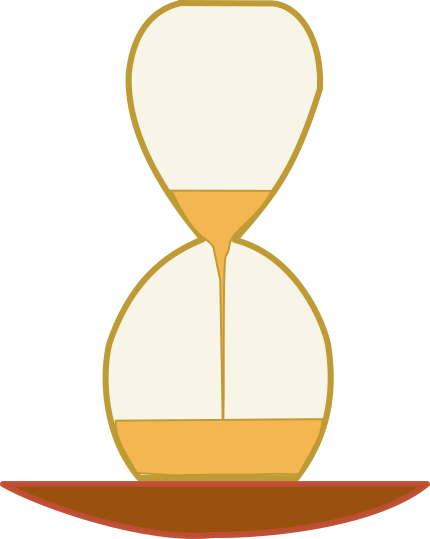
Question: It takes one hour for the 200 grams of fine sand to run through the narrow gap into the base of the hourglass.
If 80 grams of sand has gone through, how much time has passed? Options: 16 minutes, 20 minutes, 24 minutes, or 36 minutes.
Show Answer
24 minutes. Explanation: 60 (minutes) ÷ 200 (grams of fine sand) = 0.3 (This means that 1 gram of sand passes through the hourglass every 0.3 of a minute in the hour). 0.3 (minutes per gram of sand) x 80 (total number of grams of sand emptied) = 24 (minutes passed since the hourglass was turned/started).
Collectibles Matter
Question: Billy collects 2 tiny toys from the cereal packets every 5 weekdays, and 4 from his neighbours every weekend.
He also gives one away to his friend every second Monday. How many tiny toys does Billy have after one year?
Options: 299, 286, 312, or 338.
Show Answer
286 tiny toys. Explanation: 52 (weeks in a year) x 6 (2 tiny toys every 5 weekdays and 4 from his neighbours every weekend) = 312. Then to subtract the ones that Billy gives to his friend every second weekend in the year: 52 (weeks in a year) ÷ 2 (every second weekend) = 26 (the number of second weekends there are in a year). 26 (every second weekend in a year) x 1 (number of tiny toys that Billy gives to his friend every second weekend) = 26 (total number of tiny toys Billy gives to his friend in one year). 312 (total number of tiny toys Billy would have had after one year if he had not given any away) – 26 (the number of tiny toys that Billy gave away in one year) = 286 (the total number of tiny toys Billy has after one year).
Speed in Seconds
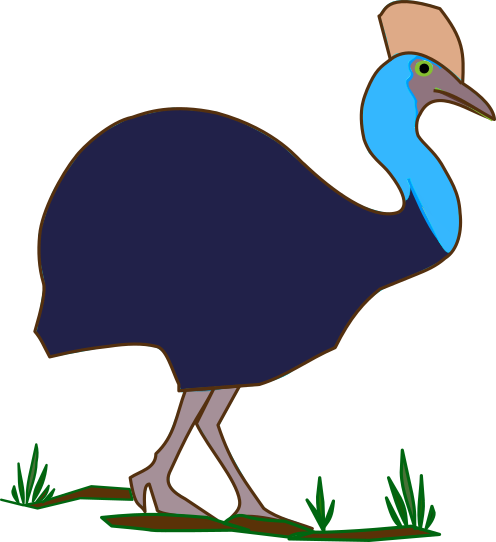
The Australian cassowary, a flightless bird, is capable of running at a speed of 50 kilometres per hour.
Which of the following is the closest to that speed per second? Options: 5 metres per second, 8 metres per second, 10 metres per second, or 14 metres per second.
Show Answer
14 metres per second. Explanation: To calculate metres per second: 50,000 (metres per hour) ÷ 3600 (seconds in an hour) = 13.88888889 which can be rounded up to 13.89 meters per second.
Number of Squares Conundrum

How many squares can you see in the diagram? Options: 9 squares, 10 squares, 12 squares, or 14 squares?
Show Answer
There are 14 squares. Explanation: If you count the most obvious squares there are nine. There are another four squares made up of four of the smaller squares each. The last square is the big square around the whole thing.
A Cryptic Note to Decode
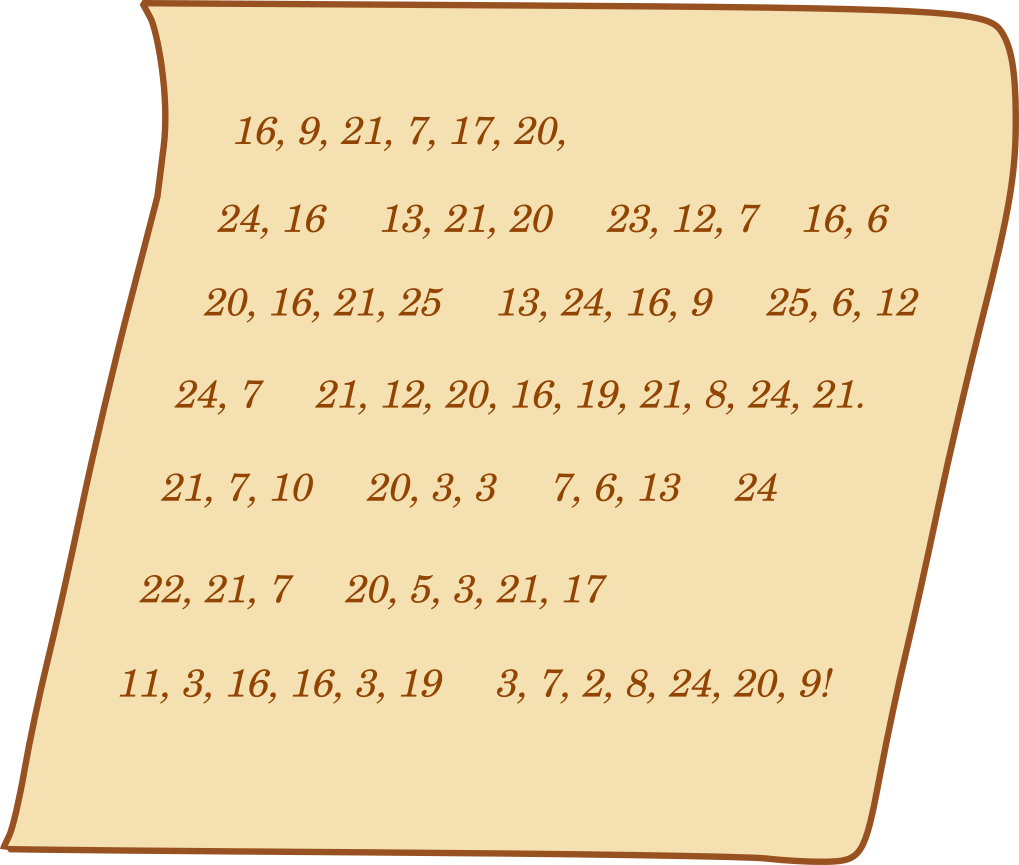
Lara, an exchange student from Japan, could speak very little English at first.
During her stay, her Australian friends, the Smiths, patiently helped her to become more fluent. When it was time to leave, Lara handed her new friend, Cassandra Smith, a piece of paper with a cryptic message on it. At first Cassandra could not understand it, but after she had managed to decode the message, she laughed. Here is the message. See if you can decode it.
Show Answer
16, 9, 21, 7, 17, 20 – Thanks – 24, 16 – it – 13, 21, 20 – was – 23, 12, 7 – fun – 16, 6 – to – 20, 16, 21, 25 – stay – 13, 24, 16, 9 – with – 25, 6, 12 – you – 24, 7 – in – 21, 12, 20, 16, 19, 21, 8, 24, 21. – Australia. – 21, 7, 10 – and – 20, 3, 3 – see – 7, 6, 13 – now – 24, – I – 22, 21, 7 – can – 20, 5, 3, 21, 17 – speak – 11, 3, 16, 16, 3, 19 – better – 3, 7, 2, 8, 24, 20, 9! – English! Explanation: Each of the letters of the alphabet has been assigned a number from 1 to 26. It is just a matter of working out a few possible or obvious letters/words, and you have worked out the code for most of the alphabet.
Number Series Puzzle
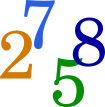
Identify the missing numbers in the series. {2, 6, __ , 20, 30, 42, _, 72,…}
Show Answer
{2, 6, 12, 20, 30, 42, 56, 72,…}. Explanation: The series is made up by multiplying a number by the previous whole number. For example (3 x 2) = 6 then (4 x 3) = 12 then (5 x 4) = 20, and so on.
Shapes Problem

On the basis of the information given in the diagram below, what symbol or symbols will go underneath the rectangle?

Show Answer
 Explanation: because the first symbol under the triangle identifies that the shape has diagonal sides, the next symbol under the triangle identifies that the shape has either horizontal or vertical sides and the round dot symbol identifies the shape as having a round portion.
Make the Connection Brainteaser
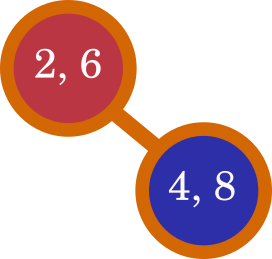
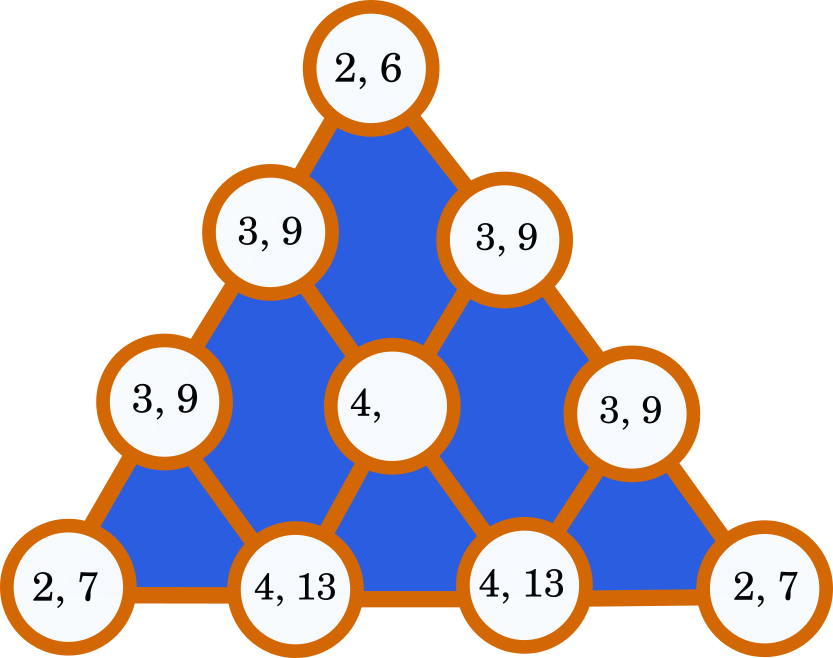
Identify the missing number in the diagram below.
Show Answer
14. Explanation: The first number in each circle is the number of branches connected to the circle. The second number in each circle is the number of branches connected to each of the circles that are connected to the circle all added together.
Reading on the Train
