Practical Learning Activity
Skills

Practical
Take notes and answer questions as you read and learn.
Introduction to Polynomials
What are Polynomials?
Polynomials are algebraic expressions (see page on Algebra ). Polynomials can be used as functions. A polynomial equation is a polynomial which is made to equal zero. Linear, quadratic, and cubic equations are all types of polynomial equations. Coefficients are the numbers before the variables in the terms of the polynomial (See page on Variables and Functions). Exponents in polynomials are the non-negative integers that the variables or constants are raised to, and that number determines the degree of the polynomial. The constant is the number which has no variable. Diagram of a Polynomial,
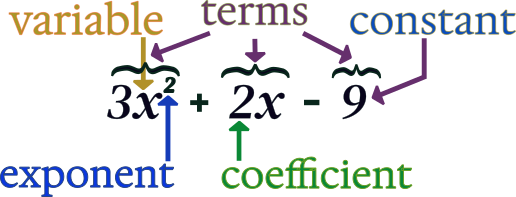
The word polynomial literally means ‘many terms.’ Polynomials come in various forms. There are monomials, which have only one term, and binomials which have two, and trinomials which have three. Polynomials can have no variables or one, two or even three variables, but do not include terms that divide by a variable, or which have fractional or negative exponents.
Non-acceptable terms for polynomials: $$\frac{2} {x},\;4x^{-2}\;,\sqrt{x}$$,
However this would be an acceptable polynomial term because we would be dividing by a constant,
$$\frac{x }{2}$$
Polynomials are ideal to work with because they contain algebraic terms that include variables and constants. They can be added, subtracted and multiplied and will still retain their polynomial identity. Since polynomials possess these characteristics, certain methods can be applied to solve them. Polynomials can be used as functions and graphed. They can be solved to find their roots, or the x-intercepts when y = 0.
Polynomials are classified by their degree, which is indicated by the highest power or exponent of a variable within the expression. For instance, the variable with the highest power in the expression, $$x^2\;+\;7x \;+\;3$$is in the first term, x, has a power of two and therefore the polynomial is called second degree.
Types of Polynomials
Constant Polynomial, 0 Degree
If there is just a number with no variable like the number 9 in the diagram at the top of this page, by itself, the expression is called constant.
Linear, First Degree
In a first degree polynomial, the highest power on a variable is one, and for that reason it is called first degree, and can also be known as a linear polynomial (see Page on Linear Equations) because the graph of such a polynomial is linear, always forming a straight line, as follows,
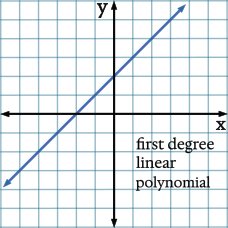
$$An\;example\;of \;a\;first \;degree $$$$\;linear \;polynomial\; expression\;is\;$$$$x\;+\;2$$
Quadratic, Second Degree
In a quadratic polynomial, (see page on Quadratic Equations ) called second degree, the highest power on a variable is two. The graph of a quadratic polynomial always forms a curved line, known as a parabola. After turning more sharply it forms a vertex and reverses its curve symmetrically, as shown here,
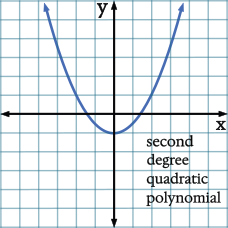
$$An\;example\;of \;a\;second \;degree $$$$\;quadratic \;polynomial\; expression$$$$\;is\;\frac{1}{2}x^2\;-\;1$$,
Cubic, Third Degree
In a cubic polynomial, called third degree, the highest power on a variable is three, and the graph of a cubic polynomial always forms a curved line, but can vary in shape. Here is an example,
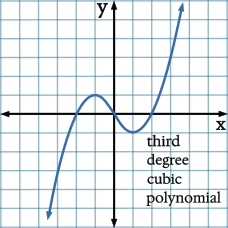
$$An\;example\;of \;a\;third \;degree $$$$\;cubic \;polynomial\; expression\;$$$$is\;y^3\;-\;4y\;$$,
See if you can answer the following questions on polynomials.
Show Answer
A binomial.
Show Answer
b) A trinomial, because it has three terms.
Show Answer
c) The highest exponent or power of a variable within the polynomial is 2.
Show Answer
a) A cubic, third degree polynomial, because the highest power a variable is raised to within this polynomial is 3.
Show Answer
c) A linear, first degree polynomial, because the maximum exponent of a variable within it is one.
Example of a Method Used to Find the x-Intercept Point of a Polynomial
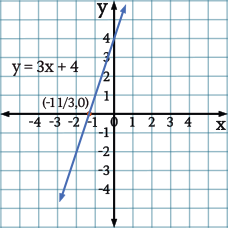
The graph of the linear equation, $$y = 3x + 4$$ is a straight line. Since it is a straight line it only crosses the x axis once.
To find the x-intercept or root, we are looking for y to equal zero so our equation becomes,
$$3x \;+\; 4\; = \;0$$
Applying algebraic methods to isolate x and balance out the two sides of the equation, we place 4 on the other side of the equals sign and make the addition sign a subtraction sign as follows:
$$3x \;= \;-4$$
To solve for x we have to isolate it further, so we move the 3 across to the other side of the equation, and change the multiply operation to the inverse operation of division as follows,
$$x \;= \;-\frac{4 }{3}$$
Simplifying the solution we get the x-intercept value for x,
$$x \;=\; – 1\frac{1}{3}\;$$
Therefore the (x, y) coordinates of the x-intercept are $$(-1\frac{1}{3},\;0)$$
Find the x-intercept point, and give the (x, y) coordinates of the x-intercept point of each of these equations.
Show Answer
$$3x\;+\;2\;=\;0$$$$3x\;=\;-2$$$$x\;=\;-\frac{2}{3}$$$$Therefore \;the \;(x,\;y)\;coordinates$$$$\;of\;the\;x-intercept$$$$are\; (-\frac{2}{3},\; 0) $$
Show Answer
$$4x^2\;-\;4\;=\;0$$$$4x^2\;=\;4$$$$x^2\;=\;\frac{4}{4}$$$$x^2\;=\;1$$$$\sqrt{x^2}\;=\;\sqrt{1}$$ $$x\;=\;±1$$$$Therefore \;the\; (x,\;y)\;coordinates$$$$\;of\;the\;x-intercept$$$$are\; (1,\; 0)\;and\;(-1,\;0) $$
Show Answer
$$2x\;+\;8\;=\;0$$$$2x\;=\;-8$$$$x\;=\;-4$$$$Therefore \;the \;(x,\;y)\;coordinates$$$$\;of\;the\;x-intercept$$$$are\; (-4, \;0) $$
Show Answer
$$6x\;-\;9\;=\;0$$$$6x\;\;=\;9$$$$x\;=\;\frac{9}{6}$$$$x\;=\;1\frac{1}{2}$$$$Therefore \;the\; (x,\;y)\;coordinates$$$$\;of\;the\;x-intercept$$$$are\; (1\frac{1}{2},\; 0) $$
Show Answer
$$5x\;-\;10\;=\;0$$$$5x\;\;=\;10$$$$x\;=\;\frac{10}{5}$$$$x\;=\;2$$$$Therefore \;the\; (x,\;y)\;coordinates$$$$\;of\;the\;x-intercept$$$$are\; (2,\; 0) $$