
Practical Learning Activity
Skills

Practical
Take notes and answer questions as you read and learn.
(See page on Factorising Polynomials)
Introduction to Quadratic Equations
Quadratic Equations: Definitions and Background
What are Quadratic Equations?
Quadratic equations are types of polynomial equations, consisting of algebraic terms (see Algebra page). The terms of a quadratic equation can include coefficients, variables and constants. Coefficients are the numbers beside the variables. Variables, like x and y, are used in the place of unknown values. Constants are plain numbers. Exponents in polynomials are the non-negative integers that the variables or constants are raised to, and that number determines the degree of the polynomial. Exponents are also known as powers or indices. A quadratic equation is called a second degree polynomial equation because the highest exponent of a variable in the equation will be 2. Diagram of a quadratic polynomial equation (below).
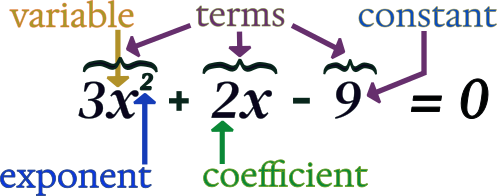
(find out more about polynomials )
Graphs of Quadratic Equations
The word quad means square. Accordingly, the square on the variable is the distinguishing characteristic of a quadratic equation. Like other polynomials, quadratic equations can be used as functions to make graphs.
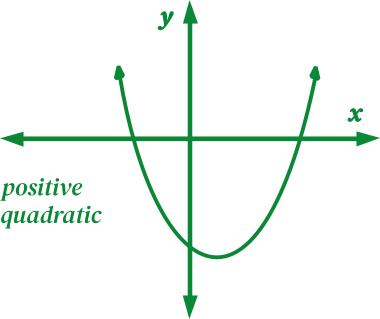
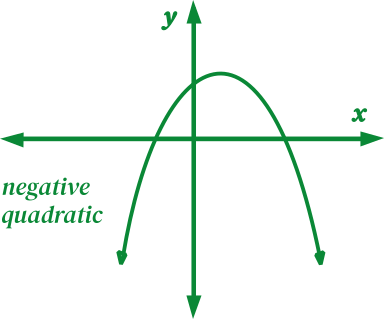
Quadratic equations always form a curved line when graphed, like those shown in the illustrations below. The square in a quadratic equation effectively causes the line to curve and then to make a distinct turn at its central axis of symmetry, before reversing in a mirror-like fashion in the opposite direction. The curved line made by a quadratic equation is called a parabola.
When Finding the Roots or x-Intercepts of a Quadratic Parabola
There are usually two solutions when you are looking to find the x-intercepts, where y = 0. The vertex of the parabola is the point at which the parabola curves the most, at the highest or lowest point of the curve, depending upon the way the curve is facing. In some cases, where the curved line is above or beneath the x axis, there will be no solutions. In a case where the parabola intercepts the x axis at its vertex, there will be one solution.
Examples of Quadratic Equations
Here are some examples of quadratic equations.
$$3x^2\;+\;4x\;+\;2\;=\;0$$
$$7x^2\;+\;2x\;-\;5\;=\;0$$
Examples of Methods Used to Solve Quadratic Equations :
The standard or general form of a quadratic equation is as follows,
$$ax^2\;+\;bx\;+\;c\; =\;0$$
For example the standard form of,
$$\;3x^2 + 4x = 2\;is$$$$\;3x^2\;+\;4x\;-2\;=\;0$$
In this case a would be 3, b would be 4 and c would be -2.
There are several methods which are used to solve for x in quadratic equations, which is otherwise known as finding the roots or where the x-intercepts are, when y = 0. Factorising is most commonly used, and if you are left to choose the method you could try this first. If you cannot easily factorise, try using the quadratic formula. Completing the square will be used often in cases where the quadratic formula cannot be used. Solving graphically is also possible. The following are examples.
Factorising the Quadratic to Solve For x – Two Examples
(Find out more about factorising polynomials)
To solve a quadratic equation for x by factorising, follow these steps where possible.
Step 1) Write the quadratic in the form where y is equal to zero as y has to equal zero to find the x-intercept points.
Step 2) Factorise the polynomial, and then make each half of the factorised polynomial equal to zero.
Step 3) Solve for x in each equation algebraically by isolating x.
Example 1:
To solve the following for x by factorising,$$x^2\;-\;6x\;=\;-9$$Begin by rewriting the equation in the standard form for quadratic equations, which is, $$ax^2\;+\;bx\;+\;c\; =\;0$$$$x^2\;-\;6x\;+\;9\;=\;0$$ This quadratic can be factorised easily because it begins with 1 as a coefficient of x squared. In such cases, begin by writing the following, $$ (x\;\;)(x\;\;)$$ leaving spaces inside the brackets after the x’s. We will factor the expression,$$x^2\;-\;6x\;+\;9\;$$Think of two numbers that can be multiplied to get the last term, 9, and that can also be added to get the middle term, -6. In this case, since -3 × -3 is 9 and -3 + -3 is -6, the two numbers are -3 and -3. Place those two numbers after the two x’s inside the brackets,$$(x-3)(x-3)$$Finally, check these are the correct factors by expanding them, to see if the result is the original expression,$$x^2\;-\;6x\;+\;9\;$$Since expanding them does give the original expression, the factors are correct, and can be expressed as,$$(x-3)^2$$
To find the roots of the quadratic, where y=0,
$$(x-3)(x-3)=0$$
We take each binomial factor and make them equal to 0, and then solve for x, as follows,
$$x-3=0\;and\;x-3=0$$
Since they are both the same, only one needs to be solved to find the solution to both. The solution for x is 3. Having just one value for x and not two is unusual (read below).
$$∴\; x = 3$$
This equation has only one solution because the vertex of the parabola, or lowest point of the parabolic curve, happens to intercept the x axis at 3, where y = 0, and then the line turns upwards again. If you plot the coordinates of this quadratic equation, and graph the parabola, you will see this.
Example 2:
To solve the following for x by factorising,$$3x^2\;+\;2x\;= \;21$$Rewrite the equation in standard quadratic form,
$$3x^2\;+\;2x\;-\;21\;= \;0$$
Then, after we have set the equation to equal 0, we then take the expression$$3x^2\;+\;2x\;-\;21\;$$To factorise it we start by finding two numbers which multiply to get the product of the coefficient of the first term,3, and the last term, -21, which is -63, and which also add together to make to the coefficient of the middle term, 2. 3 multiplied by -21 is -63. -7 multiplied by 9 is also -63. -7 and 9 also add together to make 2. Adjust the original expression, by replacing the 2 with the two new coefficients of x as the middle terms.
$$3x^2\;-\;7x\;+\;9x\;-21 \;$$
Now try to find a common factor of the two halves of the expression. Since this cannot be done, swap the two middle terms around, $$3x^2\;+\;9x\;-\;7x\;-21 \;=\;0$$ and try to find a common factor again. This can be done as follows,
$$\;3x(x \;+\;3) \;-7(x\; +\; 3)$$
Please note that the terms inside the brackets should be the same in each instance. To get the fully factorised answer, the terms which are inside the brackets are then placed inside the first set of brackets, and the terms which are outside the brackets are placed inside the second set of brackets, as follows,
$$(3x-7)(x+3)$$
Finally, check that these are the correct factors by expanding them again, to see if the result is the original expression.
$$3x^2\;+\;2x\;-\;21\;$$
Since expanding does give the original expression, these factors are correct.
To find the roots of the quadratic equation, make y = 0 as follows,
$$(3x-7)(x+3)=0$$
and set each binomial factor equal to 0, as shown here,
$$3x-7=0$$$$and\; x+3=0$$
Then solve the two equations algebraically to find x.
$$3x \;- \;7\; =\; 0\; and \;x\; + \;3 \;=\; 0$$
$$3x \;=\; 7\; and \;x\; =\; -3$$
$$solutions: \;x \;=\frac{7} {3}\; and\;x\; = \; -3$$
Check each solution by substituting the solution for x: first solution:
$$Where\; x\;= \frac{7} {3}\;$$
$$3x^2\;+\;2x\;-\;21\;= \;0$$
$$3(\frac{7} {3})^2\;+\;2 (\frac{7} {3})\;= \;21$$
$$3(\frac{49} {9})\;+\;\frac{14} {3}\;= \;21$$
$$\frac{49} {3}\;+\;\frac{14} {3}\;= \;\frac{63}{3}\;=\;21$$
$$21\;= \;21$$
Check each solution: second solution:
$$Where\; x\;= \;-3\;$$
$$3x^2\;+\;2x\;-\;21\;= \;0$$
$$3(-3)^2\;+ 2(-3)\;= \;21$$
$$3(9)\;+ 2(-3)\;= \;21$$
$$27\;+\;-6\;= \;21$$
$$21\;= \;21$$
Thus, the conclusion is made:
$$∴(meaning \;therefore)\; x \;=\frac{7} {3}\;$$$$and\; x\; = \; -3$$
Completing the Square to Solve for x
Another method used to solve quadratic equations for x is completing the square. Refer to the standard form of a quadratic equation,
$$ax^2\;+\;bx\;+\;c\; =\;0$$
To solve an equation by completing the square, a should be equal to 1. If it is not, you may have to divide all the terms by the coefficient of x squared to make it 1. However, in this case it is 1, so we can continue.
To solve the following for x by completing the square,$$x^2\;+\;4x\;+\;3\;=\;0$$
Step 1: Move the number c across from the left to the right side of the equation, changing the sign to negative. $$x^2\;+\;4x\;=\;-3$$
Step 2: Calculate half of the coefficient of x (which is b/2), square it and add it onto both sides of the equation.$$x^2\;+\;4x\;+\;2^2\;=\;-3\;+\;2^2\;$$this becomes,$$\;x^2\;+\;4x\;+\;4\;=\;-3\;+\;4$$
Step 3: Factorise the left side of the equation.$$(x+2)(x+2)\;=\;1\;$$which is $$\;(x+2)^2\;=\;1$$Step 4: Apply the square root on both sides of the equation.$$\sqrt{(x+2)^2}=\;±\sqrt{1}\;$$this becomes,$$\;x\;+\;2\;=\;±1$$
Step 5: Isolate x by moving the number on the left side of the equation to the right side of the equation to produce the solutions.$$x\;=\;±1-2\;$$$$\;x\;=\;1-2\;and\;x\;=\;-1-2\; $$$$∴\; x \;=\;-1 \;and \;x\;=\;-3$$
Using the Special Quadratic Formula to Solve for x
Refer to the standard form of a quadratic equation,
$$ax^2\;+\;bx\;+\;c\; =\;0$$
The following is the quadratic formula,
$$x=\frac{-b±\sqrt{b^2-4ac}}{2a}$$
In this example, we must first make the equation equal to zero. That will help us find the x-intercepts, as y will then be equal to 0. Given the following equation,
$$3x^2\;+\;2x\;=\;4\; $$It is rewritten in the standard form of, $$\;3x^2\;+\;2x\;-\;4\;=\;0$$
To solve the following for x by using the quadratic formula,$$\;3x^2\;+\;2x\;-\;4\;=\;0$$
With reference to the standard form of a quadratic equation, in the above equation a=3, b=2 and c=-4. After we substitute those into the quadratic formula, we get,
$$\;x=\frac{-(2)±\sqrt{(2)^2-4(3)(-4)}}{2(3)} \;$$$$\;x=\frac{-2±\sqrt{4+48}}{6}$$
$$\;x=\frac{-2±\sqrt{52}}{6}\;$$$$\;x=\frac{-2±\sqrt{4}\sqrt{13}}{6}$$
$$\;x=\frac{-2±2\sqrt{13}}{6} \;$$$$∴\; x \;=\frac{-1-\sqrt{13}}{3}\;and\;$$$$x=\frac{-1+\sqrt{13}}{3}$$
See if you can answer these twelve quadratic equation questions
Question 1:
Show Answer
$$a \;= \;3, b \;= \;2,c\;=\; 4\;$$because in standard form the equation is $$3x^2\; + \;2x\; +\; 4\; =\; 0$$
Question 2:
Show Answer
$$a \;= \;2, b \;= \;4,c\;=\; 5\;$$because in standard form the equation is $$2x^2\; + \;4x\; +\; 5\; =\; 0$$
Question 3:
Show Answer
$$a \;= \;4, b \;= \;3,c\;=\; 8\;$$in the quadratic formula$$x=\frac{-b±\sqrt{b^2-4ac}}{2a}\;$$is$$\;x=\frac{-(3)±\sqrt{(3)^2-4(4)(8)}}{2(4)}$$
Question 4:
Show Answer
$$(x\;+\;2)(x\;+\;4)$$$$(x\;+\;2)(x\;+\;4)=0$$$$x\;+\;2=\;0\;and\;x\;+\;4\;=\;0$$$$∴\; x \;=\; -2\;and\;x\;=\;-4$$
Question 5:
Show Answer
$$x^2\;+\;4x\;=\;5$$$$x^2\;+\;4x\;+(2)^{2}=\;5+(2)^{2}$$$$x^2\;+\;4x\;+4\;=\;5+4$$$$(x+2)(x+2)\;=\;9$$$$(x+2)^2\;=\;9$$$$\sqrt{(x\;+\;2){^2}}\;=\;±\sqrt{9}\;$$$$x \;+\;2\;=\;±3\;$$$$x \;=\;3\;-\;2,\;and\;x\;=\;-3\;-\;2\;$$$$∴\; x \;=\;1\;and\;x\;=\;-5\;$$
Question 6:
Show Answer
$$x^2\;+\;6x\;=\;7$$$$x^2\;+\;6x\;+\;(3)^2\;=\;7\;+\;(3)^2\;$$$$x^2\;+\;6x\;+\;9\;=\;7\;+\;9$$$$(x\;+\;3)(x\;+\;3)\;=\;16$$$$(x\;+3\;)^2=\;16$$$$\sqrt{(x\;+\;3){^2}}\;=\;±\sqrt{16}\;$$$$x\;+\;3\;=\;±4\;$$$$x\;=\;4\;-\;3\;and\;x\;=\;-4\;-\;3$$$$∴\; x \;=\;1\;and\;x\;=\;-7\;$$
Question 7:
Show Answer
$$x^2\;+\;7x\;+\;10\;=\;0$$$$(x\;+\;2)(x\;+\;5)\;$$$$(x\;+\;2)(x\;+\;5)\;=\;0$$$$x\;+\;2=0,\;x\;+\;5\;=\;0$$$$∴\; x \;=\;-2\;and\;x\;=\;-5$$
Question 8:
Show Answer
$$x=\frac{-b±\sqrt{b^2-4ac}}{2a}$$$$\;x=\frac{-(3)±\sqrt{(3)^2-4(2)(-2)}}{2(2)} \;$$$$\;x=\frac{-3±\sqrt{9+16}}{4}$$$$\;x=\frac{-3±\sqrt{25}}{4}\;$$$$\;x=\frac{-3±\;5}{4} \;$$$$\;x=\frac{-3+5}{4}\;and\;x\;= \frac{-3-5}{4}$$$$x=\;\frac{2}{4} \;and \;x=-\frac{8}{4}$$$$∴\; x \;=\;\frac{1}{2}\;and\;x=-2$$
Question 9:
Show Answer
$$x=\frac{-b±\sqrt{b^2-4ac}}{2a}$$$$\;x=\frac{-(2)±\sqrt{(2)^2-4(3)(-5)}}{2(3)} \;$$$$\;x=\frac{-2±\sqrt{4+60}}{6}$$$$\;x=\frac{-2±\sqrt{64}}{6}\;$$$$\;x=\frac{-2±\;8}{6} \;$$$$\;x\;=\;\frac{-2+8}{6}\;and\;\;x\;=\;\frac{-2-8}{6}$$$$x=\;\frac{6}{6} \;and \;x=-\frac{10}{6}$$$$∴\; \;x\;=\;1\;and\;x \;=\;-\frac{5}{3}$$
Question 10:
Show Answer
$$(x\;+\;5)(x\;+\;5)$$
Question 11
Show Answer
$$x=\frac{-b±\sqrt{b^2-4ac}}{2a}$$$$\;x=\frac{-(8)±\sqrt{(8)^2-4(4)(3)}}{2(4)} \;$$$$\;x=\frac{-8±\sqrt{64-48}}{8}$$$$\;x=\frac{-8±\sqrt{16}}{8}\;$$$$\;x=\frac{-8±\;4}{8} \;$$$$\;x\;=\;\frac{-8+4}{8}\;and\;\;x\;=\;\frac{-8-4}{8}$$$$x=\;-\frac{4}{8} \;and \;x=-\frac{12}{8}$$$$∴\; x \;=\;-\frac{1}{2}\;and\;x=-1\frac{1}{2}\;$$
Question 12
Show Answer
$$(x\;-\;4)(x\;+\;2)$$$$(x\;-\;4)(x\;+\;2)=\;0$$$$x\;-\;4=0, \;and\;\;x\;+\;2\;=\;0$$$$\;∴\; x \;=\;4\;and\;x\;=\;-2$$