
Practical Learning Activity
Skills

Practical
Take notes and answer questions as you read and learn.
Introduction to Factorising Polynomials
(See Factorising and Expanding in Algebra)
(Go to Polynomials page)
(See page on Finding Factors)
How to factorise polynomials
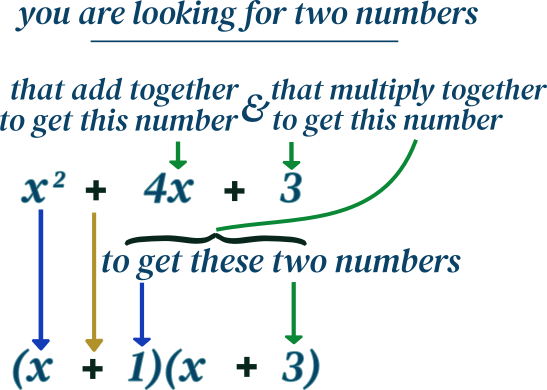
Let us try to factorise the following polynomial expression.
$$x^2+7x+6$$
We ask the question what two numbers multiply together to get the last term or constant, 6 , that also add together to make the coefficient of the middle term 7? One and six fit here. The factors are written like this,
$$(x+1)(x+6)$$
To test whether these are the correct factors, we expand the factors, by multiplying and adding each of the terms, to see if this results in the original expression,
The first and third term together: x times x = x squared
The first and fourth term together: x times 6 = 6x
The second and third term together: 1 times x = x
The second and fourth term together: 1 times 6 = 6
Adding all of these terms together, we get, $$x^2 + 6x + x + 6$$$$x^2 + 7x + 6$$Thus, the factorised answer, $$(x+1)(x+6)$$is found to be correct because the result of expanding the factors is the original expression, $$x^2+7x+6$$
Try the following five exercises to practice factorising.
Show Answer
$$(x+2)(x+3) $$
Show Answer
$$(x+3)(x+4)$$
Show Answer
$$(x+3)(x+5)$$
Show Answer
$$(x-5)(x+1)$$
Show Answer
$$(x-5)(x+2)$$
A More Difficult Example of Factorising
We begin with the polynomial expression$$4x^2\;-\;23x\;−\;6\;$$This particular expression is more difficult to factorise because the coefficient of x squared is more than 1. Factorise by finding two numbers that multiply together to get the product of the coefficient of the first term, 4, and the last term, -6, which is -24, and that also add together to make -23, the coefficient of the middle term. 4 multiplied by -6 is -24. And -24 multiplied by 1 is also -24 and also add together to make the middle term, -23. Now, using 1 and -24, as the coefficients for the middle terms variable, instead of -23, resulting in the following,
$$4x^2\;+\;x\;−\;24x\;−6$$
Now we try to find a common factor between the two halves of the expression (sometimes if we cannot, we have to swap the two middle terms around) and this can be expressed in brackets,
x(4x + 1), for the first half of the expression, -6 (4x + 1), for the second half of the expression. Please note that the terms inside the brackets should be the same in each instance, in this case (4x + 1). The next step is,
$$\;x(4x \;+\;1) \;-6(4x\; +\; 1)$$
To fully refine the answer, the terms which are inside the brackets are placed inside the first set of brackets, and the terms which are outside the brackets are placed inside the second set of brackets, as follows,
$$(4x\;+\;1)(x\;−\;6)$$
Finally, this fully factorised answer is checked by expanding these factors to see if the result is the original expression.
The first and third term together: 4x times x = 4x squared
The first and fourth term together: 4x times -6 = -24x
The second and third term together: 1 times x = x
The second and fourth term together: 1 times -6 = -6
Adding all of these terms together, we get the original expression, $$4x^2 \;- \;24x\; +\; x \;- \;6$$$$4x^2\; -\; 23x\; – \;6$$
Since expanding does give the original expression of,
$$4x^2\;-\;23x\;−\;6$$
the factorised answer,$$(4x\;+\;1)(x\;−\;6)$$ is correct.
Now try the following five exercises to practice more factorising.
Show Answer
$$3x^2\;+\;11x\;+\;6$$ can be factorised by finding the two numbers that multiply together to get the product of the first term’s coefficient and the last term, and that also add together to make the coefficient of the middle term 11. 3 multiplied by 6 is 18. And 9 multiplied by 2 is also 18 and also add together to make 11. From that information we create this expression, changing 11x to 9x and 2x. $$3x^2\;+\;9x\;+\;2x\;+\;6$$ Then we try to find a common factor of the two halves (you might have to swap the two middle terms around) which can be expressed in brackets, 3x(x + 3), for the first half of the expression, +2(x + 3), for the second half of the expression. Please note that the terms inside the brackets should be the same in each instance, in this case (x + 3). So now we have, $$\;3x(x \;+\;3) \;+2(x\; +\; 3)$$ Then to get the answer, we put the terms which are inside the brackets inside the first set of brackets, and put the terms which are outside the brackets inside the second set of brackets, as follows, $$(x\;+\;3)(3x\;+\;2)$$ Finally, check that these are the correct factors by expanding them, to see if the result is the original expression. Since expanding does give the original expression of, $$3x^2\;+\;11x\;+\;6$$ our answer is correct.$$(x\;+\;3)(3x\;+\;2) $$
Show Answer
$$2x^2\;+\;10x\;+\;x\;+\;5$$$$2x(x\;+\;5)\;+\;1(x\;+\;5)$$$$(2x\;+\;1)(x\;+\;5) $$
Show Answer
$$4x^2-12x+2x-6$$$$4x(x-3)+2(x-3)$$$$(4x\;+\;2)(x\;-\;3) $$
Show Answer
$$(x\;+\;3)(x\;-\;4) $$
Show Answer
$$2x^2\;+\;10x\;-\;3x\;-\;15$$$$2x(x+5)-3(x+5)$$$$(2x\;-\;3)(x\;+\;5) $$