Practical Learning Activity
Learn

Practical
Take notes and answer questions as you read and learn.
Introduction to Geometry
Pythagorean Theorem – Rules of Angles – sin, cos and tan – Plane Geometry Area – Plane Geometry Perimeter – Solid Geometry Volume –Solid Geometry Surface Area – Geometry Formula Questions at End of Page
Plane geometry involves 2 dimensional or drawn shapes on a flat plane or on paper, like circles, squares, rectangles and triangles.
Solid geometry involves 3 dimensional solid shapes, including shapes like cubes, spheres, and cones.
Pythagorean Theorem
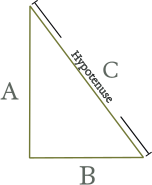
The Pythagorean or Pythagoras’ theorem applies to the lengths of the sides of a right-angled triangle,
$$a^2 + b^2 =c^2$$
where a, b and c are the three distinct sides. The longest side is C and is called the Hypotenuse.
An Example of the Use of the Pythagorean Theorem
We need to know the value of side C, which is the Hypotenuse, or the longest side in the right-angled triangle.
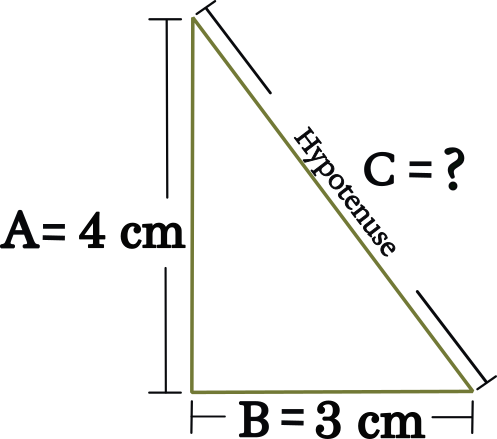
Since we already know the lengths of the other two sides, all we have to do is substitute the known values into the Pythagorean theorem and then solve it as follows,
$$A^2 + B^2 =C^2, \; $$$$step\;1:\;4^2\;+\;3^2\;=\;C^2,\; $$$$step\;2:\;16\;+\;9\;=\;C^2,\;$$
$$step\;3:\;C^2\;=\;25,\; $$$$step\; 4:\;\sqrt{C^2}\;=\;\sqrt{25},$$$$\;step\; 5:\;C\;=\;5$$
Since the square root of 25 is 5, side C is 5 cm in length.
Apply the Pythagorean theorem in this challenge
Show Answer
$$A^2 + B^2 =C^2, \; $$$$step\;1:\;15^2\;+\;b^2\;=\;17^2,\;$$ $$step\;2:\;225\;+\;b^2\;=\;289,\;$$$$step\;3:\;b^2\;=\;289\;-\;225,\; $$$$step\;4:\;b^2\;=\;64,$$$$ step\; 5:\;\sqrt{b^2}\;=\;\sqrt{64},$$$$step\; 6:\;b\;=\;8$$$$The\;length\; of \;the \;smallest\;$$$$side\;of\;the\;park\; is\; 8 \;metres$$
Rules of Angles
(See page on Rules of Angles)
Use Cos Sin and Tan Formulas to Find Angles or Sides
(See page on Trigonometry)
Plane Geometry Area
The area is the amount of area a shape takes up on a plane.
The area of a square is found by multiplying two sides as follows, with a being the length of a side, $$A(Area)\; = \;a \;× \;a, \;or \;a^2$$

The area of a rectangle is found as follows, with w being the width of a horizontal side and h being the height, $$A(Area)\; =\; w \;× \;h$$

The area of a parallelogram is found as follows, with b being the width of a horizontal side and h being the vertical height, $$A(Area)\; =\; b \;× \;h$$

The area of a triangle is found by the multiplication of one half times the base times the vertical height or, $$A(Area)\; =\frac{1}{2}\;×\;b\;×\;h$$

The area of a circle, which is the total area inside the circle, if found by the formula pi times the radius squared or, $$A(Area)\; =\pi\;×r^2$$

The area of an elipse is pi times the shortest radius, b, times the longest radius,a, or $$A(Area)\; =\pi\;×\;b\;×\;a$$

The area of a trapezoid is found as follows, with a being a shortest horizontal side and b being a longest horizontal side and h being the vertical height.,$$A(Area)\; =\; \frac{1}{2}(a \; +\;b)\;×\;h$$

The area of a sector is found with, with r being radius and θ = angle in radians, or in the second case θ = angle in degrees,$$A(Area)\; =\;\frac{ θ }{2}× r^2,\;$$$$or \;\frac{θ}{360°}×\pi\;×\;r^2$$

Plane Geometry Perimeter
The perimeter is the outer measurement of the shape right around the edge once.
The perimeter of a square is the total of the four sides, which is found as follows, with a being the length of a side,$$P(Perimeter)\; = \;a \;× \;4, \;$$

The perimeter of a rectangle is found as follows, with w being the width of a horizontal side and h being the height,$$P(Perimeter)\;$$$$P =\; 2\;×\;w \;+\;2\;×\;h\;$$

The perimeter of a triangle is all of the sides added together and is found as follows, with a, b and c being each side’s lengths, $$P(Perimeter)\;$$$$P\; = \;a \;+\;b\;+\;c$$

The perimeter of a circle, also known as the circumference, with r being the radius or half of the diameter, is found as follows, $$P(Perimeter)\; = 2\;×\;\pi\;×\;r$$

The perimeter of an elipse does not have a closed form expression, but is found where a is the semi-major axis and with b being the semi-minor axis,$$P(Perimeter)\;=\;2\pi\sqrt{\frac{a^2+b^2}{2}}, $$

The perimeter of a trapezoid or trapezium is found as follows, with a, b, c and d being each sides’s lengths. $$P(Perimeter)\;$$$$P = \;a \;+\;b\;+\;c\;+\;d$$

The perimeter of a sector is found as follows, where r is the length of the radius and a is the arc length,$$P(Perimeter)\; = \;2r + a$$

Solid Geometry Volume
The total volume of a right prism which has lateral faces perpendicular to its bases is (Volume V= Base × Height)
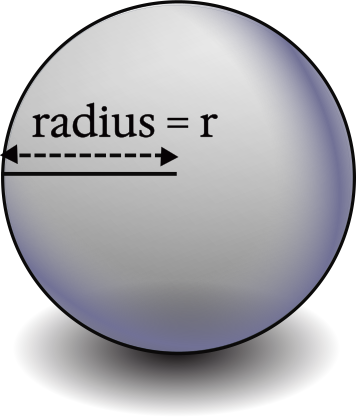
The volume of a sphere is found as follows, where r is the radius of the sphere,$$V(Volume)\; =( \frac{4}{3})×\pi\;×\;r^3$$
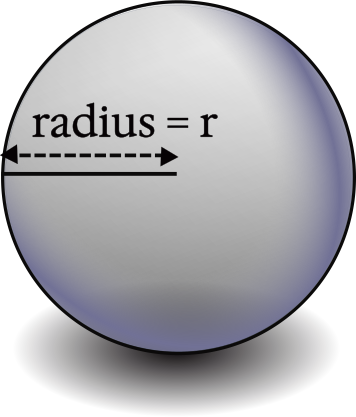
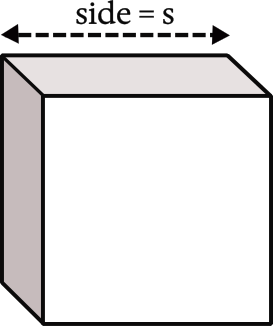
The volume of a cube is found as follows, where s is the length of one side of the cube, $$V(Volume)\; =\; s ^3$$
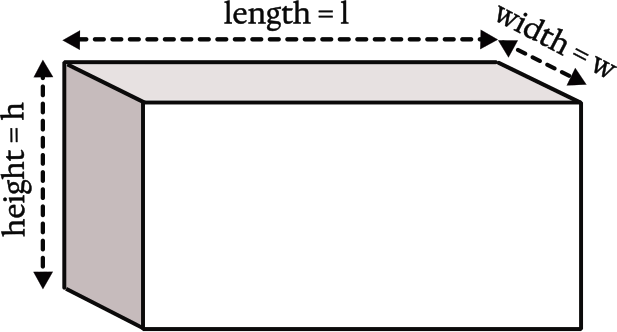
The volume of a rectangular prism is found as follows, with l being the length, w being the width and h being the height,$$V(Volume)\; =\; l \;× \;w\;× \;h$$
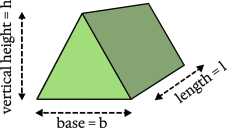
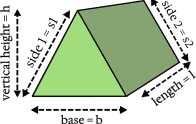
The volume of a triangular prism is one half times the base times the vertical height times the length or, $$V(Volume)\; $$$$V\;=\frac{1}{2}\;×\;b\;×\;h\;×\;l$$
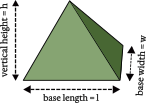
The volume of a pyramid with a rectangular base is found as follows, where l is the base length and w is the base width and h is the vertical height.$$V(Volume)\; =\frac{1}{3}×l×w×h\;$$
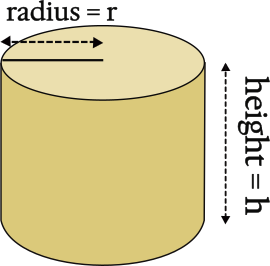
The volume of a cylinder is pi times the radius squared, times the height or, $$V(Volume)\;=\pi\;×\;r^2\;×\;h$$
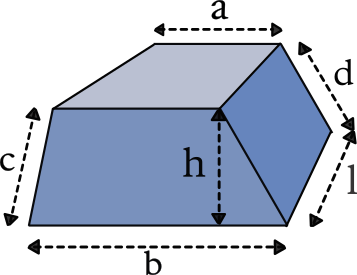
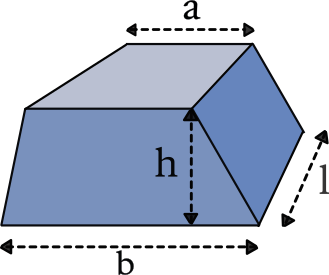
The volume of a trapezoidal prism is found as follows, with a being a shortest horizontal side and b being a longest horizontal side and h being the vertical height and l being length,$$V(Volume)\;$$$$V\; =\; \frac{1}{2}(a \; +\;b)\;×\;h×\;l$$
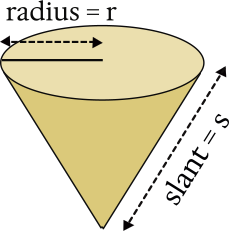
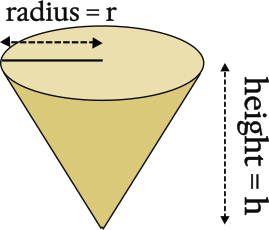
The volume of a cone is found as follows, with r being radius and h being vertical height, $$V(Volume)\;$$$$V\; =\;\frac{1}{3}×\pi\;×\;r^2\;×\;h, \;$$
Solid Geometry Surface Area
Generally the total surface area of a right prism which has lateral faces perpendicular to its bases is (2 × The Area of the Base) + (Base Perimeter × Height of Prism)
The surface area of a sphere is found as follows, where r is the radius of the sphere,$$SA(Surface\;Area)\; $$$$SA\;= 4\;×\pi\;×\;r^2$$
The surface area of a cube is found as follows, with s being the length of one side of the cube,$$SA(Surface\;Area)\; $$$$SA\;=\; 6\;×\;s^2$$
The surface area of a rectangular prism is found as follows, with l being the length, w being the width and h being the height,$$SA(Surface\;Area)\;\; $$$$SA\;=\; 2(lw \;+ \;wh\;+ \;lh)$$
The surface area of a triangular prism is two times the base area and base perimeter times the vertical height or $$SA(Surface\;Area)\;$$$$SA\;=\;bh\; +\; (s1 \;+ \;s2 \;+ b)l\;$$
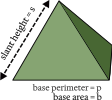
The surface area of a pyramid with a rectangular base is found as follows, where b is the base area, p is the base perimeter and s is the slant height.$$SA(Surface\;Area)\; $$$$SA\;=\; b\;+\frac{1}{2}ps\;$$
The surface area of a cylinder is pi times the radius squared, times the height or $$SA(Surface\;Area)\; $$$$SA\;=2\;×\;pi\;×\;r\;×\;(r+h)$$