Practical Learning Activity
Skills

Practical
Take notes and answer questions as you read and learn.
Introduction to Trigonometry
In maths, Trigonometry is used to find angles and side lengths of triangles. It has widespread practical applications in science and engineering.
What is Trigonometry?
Trigonometry, from trígōnon (Ancient Greek) and métron (Ancient Greek) literally means triangle measure. Using algebra, known relationships which exist between angles and sides of triangles are used to calculate unknown variables. (See Page on Algebra).
With regard to any right-angled triangle, (See Page on Geometry) through trigonometry we can find reasonably accurate values for the length of any side or for the amount of any angle, as long as we have already have enough information about the other parts of the triangle.
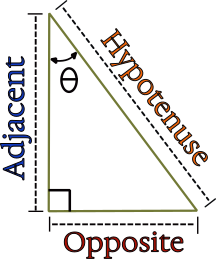
In the diagram of a right-angled triangle (shown above), we see the Hypotenuse, which is always the longest side. The θ sign, or Greek small letter theta, is often used to indicate an angle. This sign can be any angle in the triangle apart from the right angle. The names given to the different sides of the triangle are Opposite, Adjacent and Hypotenuse, and are always applied to the triangle with reference to the angle theta or a known angle. The side opposite the theta or given angle is labelled Opposite, if it is not the Hypotenuse or longest side. The side next to the theta or given angle, is called the Adjacent, if it is not the Hypotenuse or longest side.
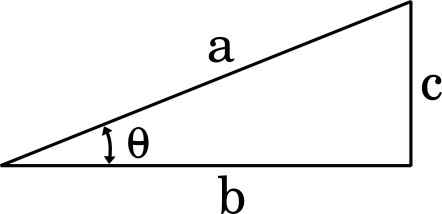
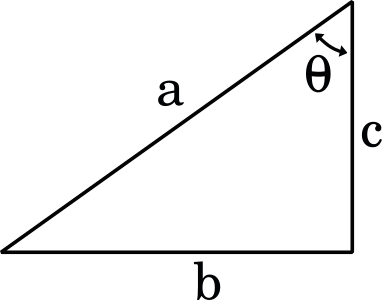
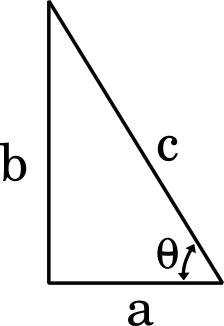
Assuming the following triangles are all right-angled, attach the correct trigonometric names to each of their sides. Remember the sides are named in reference to the angle.
Show Answer
For the triangle below, a is the Hypotenuse, b is the Adjacent and c is the Opposite
Show Answer
For the triangle below, a is the Hypotenuse, b is the Opposite and c is the Adjacent
Show Answer
For the triangle below, a is the Adjacent, b is the Opposite and c is the Hypotenuse
The following are three trigonometric ratios which include side lengths and angles, which can be applied to any right-angled triangle to find the value of any unknown side length or angle.
$$sin\;θ\;= \;\frac{Opposite}{Hypotenuse}$$
$$cos\;θ\;= \;\frac{Adjacent}{Hypotenuse}$$
$$tan\;θ\;= \;\frac{Opposite}{Adjacent}$$
Shorter versions of these ratios are easier to write, and they are, $$S=\frac{O}{H}$$$$C=\frac{A}{H}$$$$T=\frac{O}{A}$$ An easy way to remember these ratios is by memorising the words SOH CAH and TOA which are made with the first letters of each of the above words.
We use these trigonometric ratios algebraically, by substituting the known values into them, and then using what we know to find the unknown value. To determine which of the ratios you use, you first have to see what information is already given to you about the triangle. For instance if you need to know an angle, and already know the values of the lengths of the Opposite and the Adjacent sides of the triangle, the best ratio to use will be the tan ratio, which is listed third in the above ratios.
Example One of Trigonometry
For example, a builder wishes to find the height of a wall in metres, which is shown as h here,
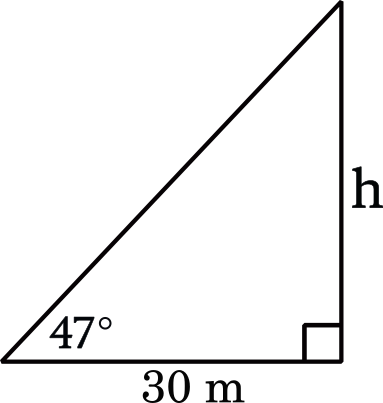
Since we have been given the values for the lengths of the Opposite and the Adjacent, we use the tan trigonometric ratio, which is,
$$tan\;θ\;= \;\frac{Opposite}{Adjacent}$$
We make the following equation by substituting the known values of the Angle and the Adjacent,
$$tan\;(47°)\;= \;\frac{h}{30}$$
We can then algebraically solve this, by multiplying both sides of the equation by 30, in order to eliminate 30 from the fraction on the right side of the equation. The reason we do this is to isolate the unknown variable, which is h, and to algebraically balance out the equation.
$$30\;×\;tan(47°)\;= \;h$$
$$h ≈ 32.17\;m$$
Example Two of Trigonometry
In a second example, we are given the following problem, which asks us to find the value of the angle θ, giving the answer to the nearest degree.
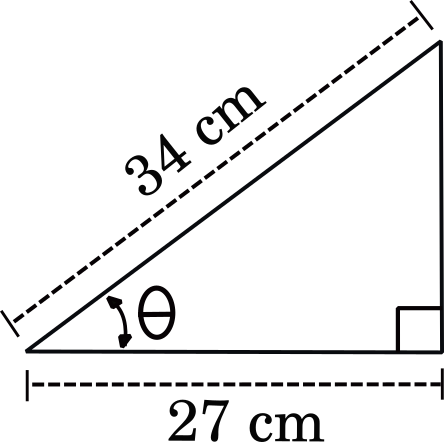
Since we have been given the values for the lengths of the Hypotenuse and the Adjacent, we use the cos trigonometric ratio which is,
$$cos\;θ\;= \;\frac{Adjacent}{Hypotenuse}$$
We make the following equation by substituting the known values,
$$cos\;θ\;= \;\frac{27}{34}$$
Then we solve for θ by applying the inverse cos function, known as $$cos^{-1}$$ to each side of the equation, to algebraically balance out the equation in order to isolate the unknown variable, which in this case is the angle, theta. So our equation is now,
$$θ\;= \;cos^{-1}(\frac{27}{34})$$
$$≈\;37°$$
Example Three of Trigonometry
In a third example, we are given the following problem, which asks us to find the value of the angle θ, giving the answer in degrees and minutes.
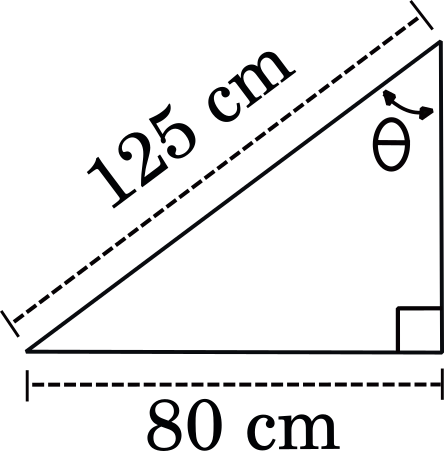
Since we have been given the values for the lengths of the Hypotenuse and the Opposite, we use the sine trigonometric ratio which is, $$sin\;θ\;= \;\frac{Opposite}{Hypotenuse}$$
We make the following equation by substituting the known values,
$$sin\;θ\;= \;\frac{80}{125}$$
Then we solve for θ by applying the inverse sin function, known as $$sin^{-1}$$ to each side of the equation, to algebraically balance out the equation in order to isolate the unknown variable, which in this case is the angle, theta. So our equation now becomes,
$$θ\;= \;sin^{-1}(\frac{80}{125})$$
$$\;=\;39.7918195$$
To find the degrees and minutes we first take the whole number, 39, as the number of degrees,
$$39°\;$$
To find the minutes we multiply everything which appeared to the right of the decimal point or the decimal remainder by 60. $$minutes\; =\; .7918195\; × \;60\;$$$$ =\;47.50917 $$
If we were also calculating seconds, we would then take the new decimal remainder from the minutes and multiply that by 60. In this example, we are only looking to find the minutes, so we will need to round the decimal remainder up or down to the nearest minute.
The rounding rule for any decimal angle is that any decimal value of point five or higher rounds up to the next whole number, while lower values round down. So, since in this example we are only calculating the minutes,’ , and not the seconds,”, we round 47.50917 up to 48 minutes.
$$minutes\;≈\;48’$$
Thus, the answer is thirty-nine degrees and forty-eight minutes, shown as,
$$≈\;39°48’$$
Test your knowledge of elementary trigonometry with these questions
Show Answer
$$a)\; sin\;θ\;= \;\frac{Opposite}{Hypotenuse} $$
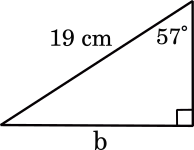
Show Answer
$$c)\;tan\;θ\;= \;\frac{Opposite}{Adjacent}$$
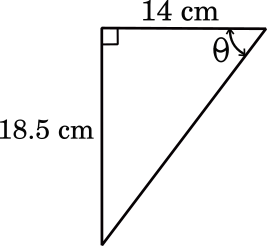
Show Answer
$$b)\;cos\;θ\;= \;\frac{Adjacent}{Hypotenuse} $$
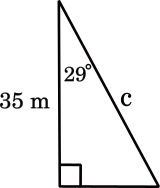
Show Answer
$$b)\;cos\;θ\;= \;\frac{Adjacent}{Hypotenuse}$$
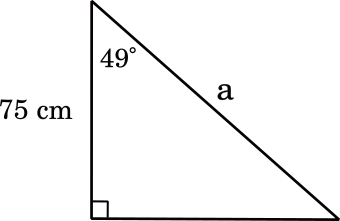
Show Answer
$$b)\;cos\;θ\;= \;\frac{Adjacent}{Hypotenuse}$$$$\;cos\;(33°)\;= \;\frac{a}{108}$$$$108\;×\;cos\;(33°)\;= \;a$$$$a\;≈\;90.58 \;cm$$
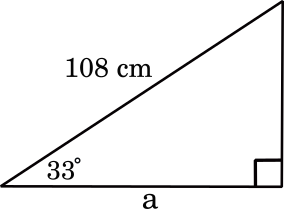
Show Answer
$$tan\;θ\;= \;\frac{Opposite}{Adjacent}$$$$tan\;(42°)\;=\;\frac{h}{45}$$$$45\;×\;tan\;(42°)\;= \;h$$$$h\;≈\;40.52 \;m$$
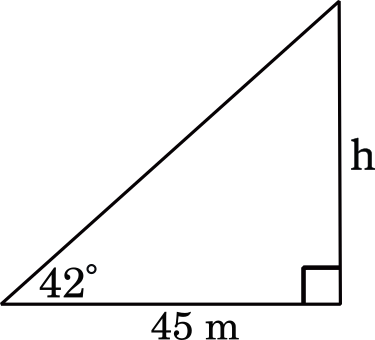
Show Answer
$$tan\;θ\;= \;\frac{Opposite}{Adjacent}$$$$tan\;(67°)\;=\;\frac{a}{12}$$$$12\;×\;tan\;(67°)\;= \;a$$$$a\;≈\;28.27\;m$$
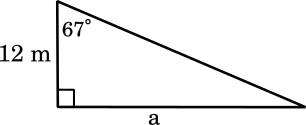
Show Answer
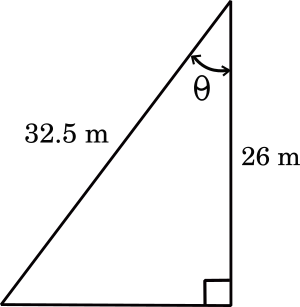
$$\;cos\;θ\;= \;\frac{Adjacent}{Hypotenuse}$$$$cos\;(θ)\;= \;\frac{26}{32.5}$$$$θ\;= \;cos^{-1}(\frac{26}{32.5})$$$$≈\;37°$$